 Retro Replay Retro Gaming History, Reviews & Emulation
Retro Replay Review
Gameplay
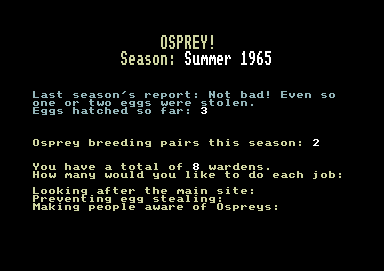
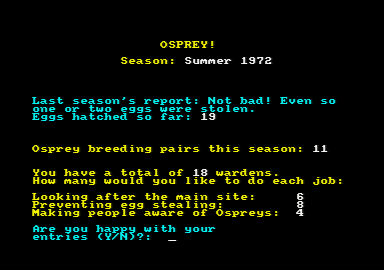
Osprey! starts with a pleasingly sober proposition: a handful of decisions may determine whether a fragile breeding population survives. Each season, you assign available wardens between guarding the main site from disturbance, deterring egg stealing, and raising awareness of ospreys. None of those jobs feels safely disposable, which gives the game more pressure than its educational label initially suggests.
The strongest part is the way limited staffing forces compromise. Put too much attention on the nesting site and another threat may go insufficiently addressed; spread people too thinly and you risk doing nothing well enough. Weather can also affect results, so you cannot treat a good plan as a guaranteed solution. That uncertainty suits the subject: conservation is presented as sustained, imperfect work rather than a puzzle with one clean answer.
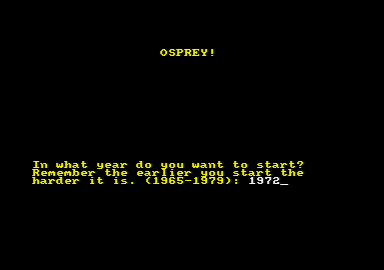
Choose an earlier starting year and the challenge rises, giving committed players a reason to revisit the campaign from a less forgiving position. Still, this is a compact management exercise built around repeated seasonal judgment, not a game of constant escalation. If you enjoy weighing constrained priorities and accepting that a bad outcome can follow a reasonable decision, its restraint starts to click. If you need lots of distinct actions or rapid novelty, the loop may wear thin.
Graphics
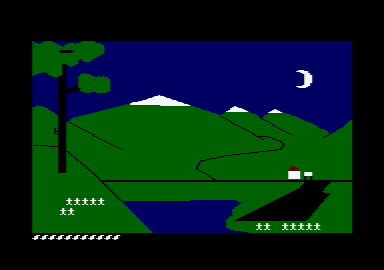
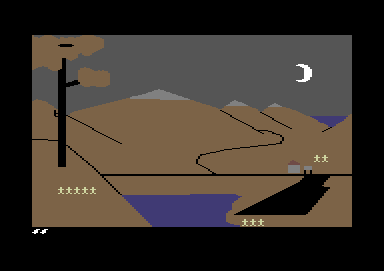
Visual spectacle is not what carries Osprey!. Its impact comes from the situation you are asked to manage: breeding birds, scarce wardens, and a real site whose future can be damaged by human pressure. That places it firmly in the tradition of educational software that wants you to think through a problem rather than be dazzled by it.
That modestness can work in its favor. A more ornamental approach might have softened the uncomfortable clarity of the choices, whereas the game’s premise keeps attention on results and responsibility. When you are deciding where protection is most urgently needed, the subject itself supplies the tension.
There is a trade-off, though. Anyone approaching a Commodore 64, Amstrad CPC, or BBC Micro game hoping for visual character to do much of the entertainment work should temper expectations. Here, the memorable image is conceptual: a small conservation effort trying to hold back several threats at once.
Story
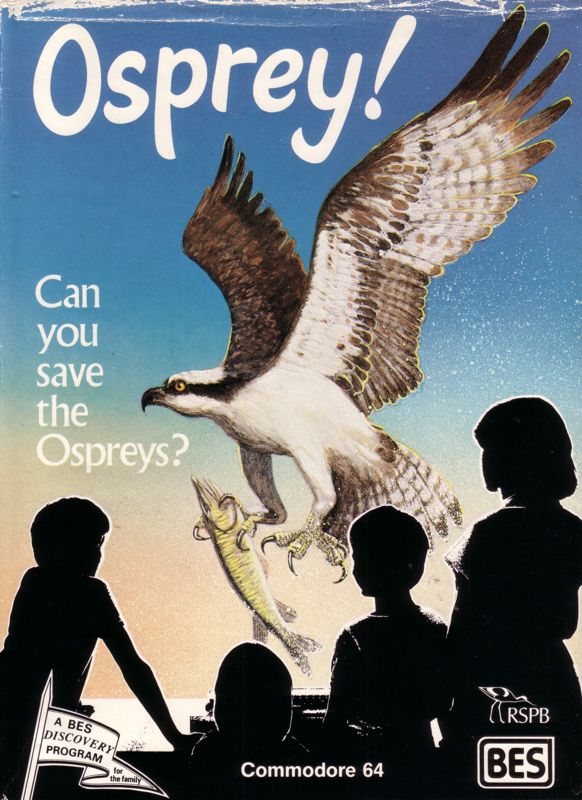
This is not a conventional story game, but it has a stronger narrative foundation than many simulations. You lead the RSPB’s “Save the Ospreys!” project at Loch Garten after ospreys returned to breed in Scotland following years in which they had been only rare visitors. Your campaign turns that history into a sequence of vulnerable seasons where survival cannot be taken for granted.
The educational framing earns its place because it is tied directly to your choices. Preventing disturbance, protecting eggs, and building wider awareness are not arbitrary categories invented to pad out a management game; they express different forms of protection with different consequences. That makes success feel more meaningful than simply reaching an abstract target.
The accompanying material deepens the connection by covering osprey history in Scotland and including breeding figures from 1954 to 1981 for comparison with your own results. For the real context behind the setting, the RSPB’s history at Loch Garten is worthwhile reading. The game’s subject remains more compelling than any invented plot could have been.
Overall Experience
Osprey! is a sincere, focused conservation simulation whose best moments come when a small staffing decision stops feeling small. It turns ecological stewardship into a practical question of priorities, then refuses to promise that careful work will always be enough. For an educational game, that is admirably honest.
Its limited range will be the dividing line. You spend your time revisiting the same three areas of responsibility under changing staffing levels and weather, so the game depends heavily on whether its central dilemma grabs you. There is no indication of a broader management sandbox waiting beyond that core, and you should not expect one.
Give it a chance if you value historical educational games, conservation themes, or lean simulations with consequential trade-offs. The payoff is less about mastery in the usual sense and more about understanding why protecting a recovering species demands vigilance year after year. It is a worthwhile experiment, even if its specialized design keeps it from being an easy all-purpose recommendation.


Reviews
There are no reviews yet.