 Retro Replay Retro Gaming History, Reviews & Emulation
Retro Replay Review
Gameplay
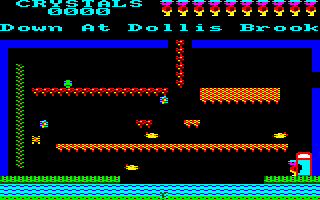
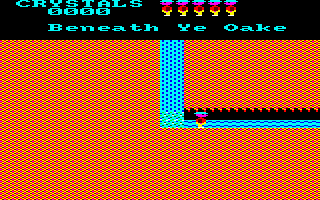
Roland in Time wastes no time dressing up its goal. You move through 53 scenes, hunting the crystals needed to power Roland’s Anti-Matter Space-Time Run-ArounD’ and trying not to lose all nine regeneration tanks along the way. That clarity is its strength: from the first stretch, you know why every dangerous screen matters and what the whole journey is building toward.
The length gives the game more bite than a one-sitting platformer. A crystal hunt spread across Earth’s past and future asks you to stay engaged for the long haul, while the enemies make each scene an obstacle rather than just another stop on a route. Nine lives sound generous until you consider the number of scenes ahead; the pressure comes from preserving that limited reserve instead of casually burning through attempts.
There is a pleasingly old-fashioned purity to it. You are not juggling a pile of systems or chasing side activities: you are pushing Roland onward, avoiding baddies, and recovering what he needs to leave. Keyboard and joystick support also lets you use the input method that feels more natural for an Amstrad platform game. The trade-off is that the central loop has to carry almost everything, so your enjoyment will depend on whether repeated scene-by-scene progress feels satisfying rather than wearing.
Give it a chance if a focused, demanding platform trek sounds better than a sprawling adventure. The payoff is the satisfaction of steadily reclaiming the crystals and surviving a notably long sequence of stages. It is less likely to win over anyone who needs frequent mechanical surprises or a relaxed path to the finish.
Graphics
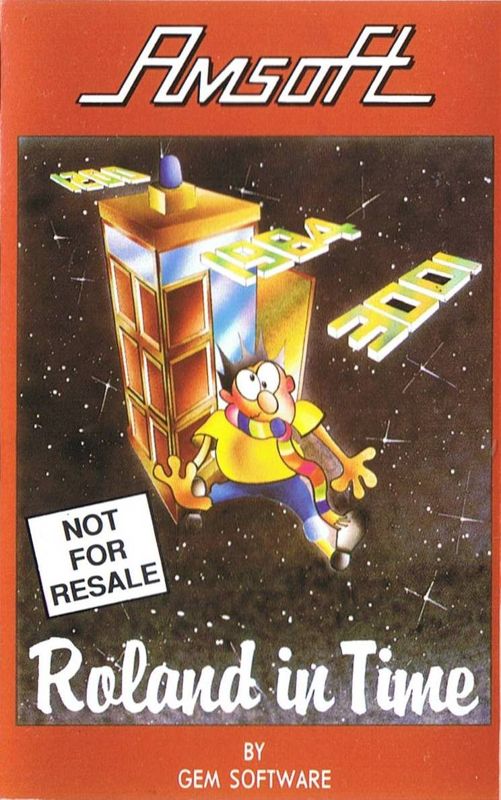
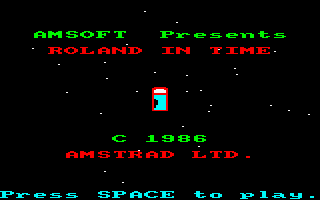
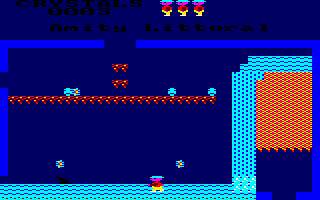
The clearest visual flourish is Roland’s time-travelling vehicle, the Anti-Matter Space-Time Run-ArounD’, which resembles a police box. It gives the game’s premise an immediately recognizable focal point and fits the playful science-fiction tone of Roland being bounced through Earth’s past and future.
Story
Maestro’s sabotage is a compact but effective reason to get moving. Roland is stranded on Earth, his escape vehicle has been drained of the crystals it needs, and the culprit has scattered those crystals across different eras. You are not asked to untangle a complicated plot; the premise puts a clear personal problem in front of Roland and sends you out to solve it.
Using Earth’s past and future gives the chase a bigger frame than its simple rescue-the-vehicle setup suggests. Each recovered crystal is a concrete piece of Roland’s route home, so the story goal and the game goal point in the same direction. That is exactly what this kind of arcade platformer needs.
Do not come expecting a narrative-heavy showdown with Maestro. The villain works chiefly as the source of the predicament, while Roland’s journey supplies the momentum. For a 1985 single-player platform game, that clean setup is enough: it gives the obstacle course a destination.
Overall Experience
Roland in Time is strongest when you meet it on its own uncomplicated terms. It turns a stranded-hero premise into a long-form platform challenge, then trusts the crystal hunt, hostile encounters, and finite lives to create tension. There is something inviting about how plainly it states the job and how much ground it expects you to cover.
The 53-scene scope is both the recommendation and the warning. It promises a substantial journey for an Amstrad CPC game, but it also means you need patience and a tolerance for setbacks. If you are the kind of gamer who enjoys earning progress through careful play rather than being ushered from one spectacle to the next, that persistence can become the point.
At its best, the game feels like a sturdy 8-bit expedition: one character, one stranded time machine, a stack of crystals to recover, and a limited number of chances to make it happen. It is worth playing for fans of the Roland series and for anyone who enjoys direct, era-appropriate platform design. Others may admire its premise more than they enjoy the sustained challenge, but its focused sense of purpose remains easy to respect.
Reviews
There are no reviews yet.