 Retro Replay Retro Gaming History, Reviews & Emulation

Retro Replay Review
Gameplay
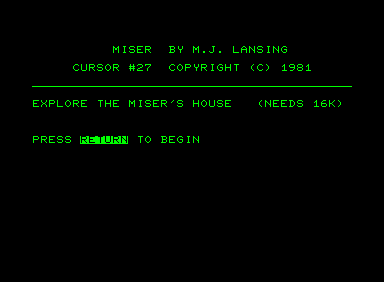
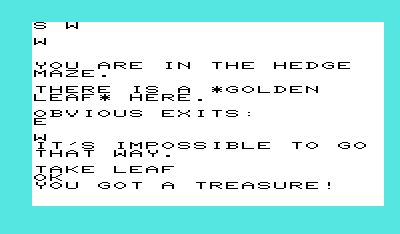
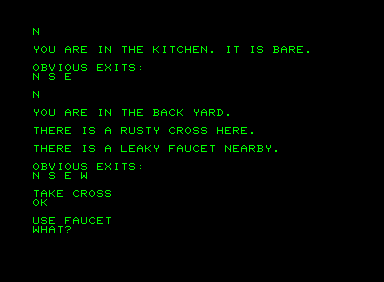
The Miser’s House starts with the purest possible text-adventure invitation: you are in a house, so start exploring. There is no elaborate mission briefing to lean on, and the first-hour pull comes from trying rooms, testing objects, and seeing what might earn part of the game’s 100 available points.
That open start is inviting if parser adventures have always sounded interesting but intimidating. The game keeps its text light and its puzzles relatively simple, so you can focus on learning the satisfying routine of examining a space, making a connection, and getting rewarded for it. It is a friendlier fit for a first-time adventurer than a game built around dense writing or elaborate puzzle chains.
The trade-off is that the house has to supply its own momentum. With no initial goal beyond exploration and score, you may hit a stretch where wandering feels aimless rather than mysterious. If you enjoy making your own checklist and treating points as a reason to investigate every lead, that sparseness works. If you need a strong stated objective to keep pushing forward, frustration can set in early.

Graphics
This is a text-driven adventure, so the house is largely something you build in your head from its descriptions and your own map of where you have been. Its fixed, flip-screen structure gives exploration a room-by-room rhythm rather than the feeling of moving through a continuously depicted space.
Story
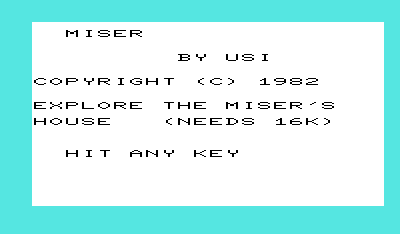
The Miser’s House is more a premise than a heavily scripted tale. You are exploring the titular house, and the game does not front-load a larger purpose beyond that urge to look around and solve puzzles.
For some players, that blank space is useful. You can treat each new discovery as its own small reward instead of waiting for plot beats to arrive, which suits a short, puzzle-led adventure.
Still, the thin framing means the story will not carry you through a difficult moment. Your investment comes from curiosity about the house and the satisfaction of raising your score, not from a dramatic narrative hook.
Overall Experience
The Miser’s House has a modest but honest charm: it is a straightforward invitation to explore a house through a text parser and collect all 100 points. It does not demand much setup, and its accessible puzzle design makes it easy to understand why it could serve as a first stop for someone curious about early interactive fiction.
Its limitations are also plain. Low text and light guidance leave little to hold onto if the act of mapping and probing rooms does not already appeal to you. Experienced adventure fans may find the puzzle work slight, while newcomers may appreciate not being buried under obscure logic.
Give it a chance when you want a brief, uncomplicated parser exercise rather than a sprawling story. The payoff is modest but real: a clean little tour of the old-school pleasure of entering commands, uncovering solutions, and watching a score climb because you were curious enough to keep looking.



Reviews
There are no reviews yet.