 Retro Replay Retro Gaming History, Reviews & Emulation
Retro Replay Review
Gameplay
The first few turns of Battlefront can feel wonderfully intimidating. You are looking at a broad battlefield, a fixed timetable, and up to a dozen regiments that cannot simply be pushed square by square like obedient counters. You decide what each regiment should attempt, but its commander interprets that order according to skill, terrain, and pressure from the enemy. That gap between your plan and its execution is the whole point, and it gives each decision weight.
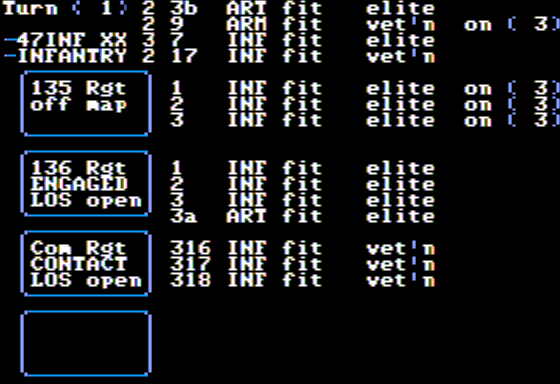
Once the rhythm clicks, the game becomes a tense exercise in making limited authority count. Turns cover six hours, so every attack or movement order is a commitment rather than a fussy series of tiny adjustments. You have to think about where a regiment needs to be, whether it can receive orders through its divisional chain, and whether supply can sustain it once fighting begins. A spectacular-looking advance that severs its own supply or command line can quickly turn into dead weight.
Combat is not just about throwing strength at an objective. Battalion experience, morale, terrain, artillery, and the allocation of air and naval support all feed into the bigger operational problem. Enemy troops are visible on the map, but useful intelligence depends on contact and cover, which keeps certainty at arm’s length. Frustration can set in when a regiment fails to carry out the grand maneuver you had in mind, yet that is usually Battlefront forcing you to revise a bad assumption rather than merely punishing you.
The scenario editor is a major bonus for a game built around maps and operational puzzles. Being able to alter terrain and even invoke the editor during play invites experimentation, while solitaire, two-player, and computer-versus-computer observation modes give the system different ways to breathe. This is not a casual pick-up-and-play strategy game, but it has the kind of rules that reward patience with genuine command dilemmas.
Graphics
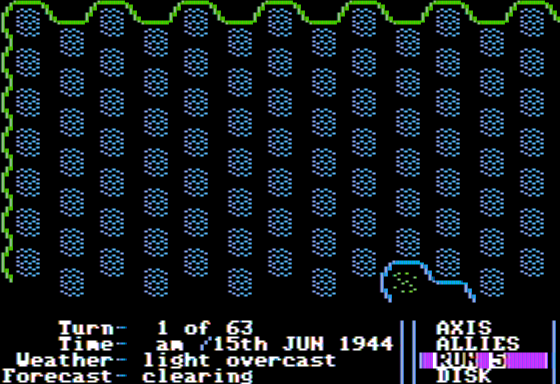
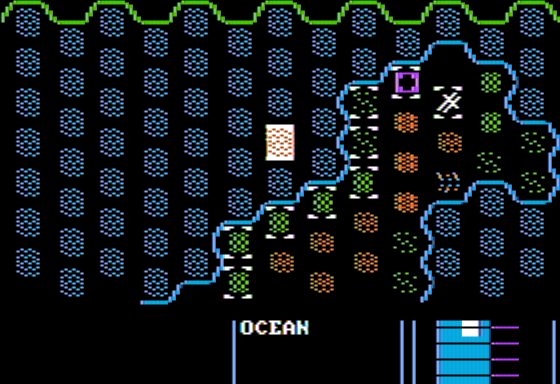
The main view is a scrollable top-down battle map filled with terrain and unit positions, while the lower quarter of the screen holds the order menus and terrain and unit information. It is a functional battlefield view rather than a decorative one, built to let you survey a large operation and issue commands without losing the wider situation.
Story
Battlefront tells its story through military objectives and deadlines rather than through character drama. Each of its four historical settings—Crete in 1941, Stalingrad in 1942, Saipan in 1944, and Bastogne in 1944–45—asks you to make a campaign-level situation work under pressure.
That approach suits the subject. You are not following a scripted tale; you are dealing with the consequences of a plan after it meets terrain, enemy resistance, morale, and the limits of communication. Holding the required ground on time matters more than chasing a tidy battlefield.
The scenarios also give the game useful variety without changing its central question: can you coordinate an imperfect force well enough to meet a demanding objective? The answer rarely comes from one brilliant attack. It comes from keeping the right regiments supplied, connected, and committed to the right piece of ground.
Overall Experience
Battlefront is for the strategy gamer who wants command friction to be part of the challenge, not something abstracted away. Its strongest idea is that a corps commander gives direction, not direct control. That makes it slower and less immediately gratifying than a conventional counter-pushing war game, but far more satisfying when a difficult timetable is met.
You will need to accept that clear intentions can produce messy outcomes. Regimental officers make tactical choices, intelligence is imperfect, and supply lines can matter as much as the front line. If that sounds irritating, Battlefront will likely feel stubborn. If it sounds like the reason to play a World War II operational game, it has real bite.
The payoff is a compact but deep command simulation with four distinct historical operations, serious logistical concerns, and unusual room to experiment through its editor. Battlefront does not flatter you with effortless control. It asks you to plan well, adapt quickly, and live with the results—and that makes success feel earned.


Reviews
There are no reviews yet.