 Retro Replay Retro Gaming History, Reviews & Emulation
Retro Replay Review
Gameplay
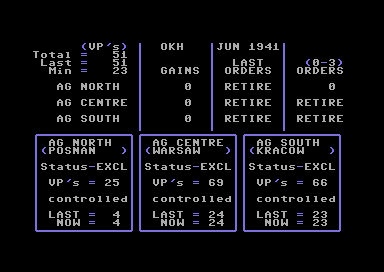
The first hour is less about making dramatic attacks than learning to give clear orders and resist the urge to command every formation yourself. You are directing German Oberkommando des Heeres or Soviet Stavka across the full Eastern Front, assigning objectives and stances to armies while corps-sized units operate under computer control. That is a bold division of labor: you set the plan, then watch whether the machinery underneath carries it out.
It will frustrate anyone who wants to move each unit personally. Handing corps movement to the computer means a plan can feel less precise than the one in your head, and the menu-driven interface asks for patience before its strategic rhythm starts to click. Yet the abstraction has a real payoff. Rather than spending your turn shuffling every corps, you are judging where an army should press, hold, recover, or withdraw, which is exactly the level where a vast four-year campaign becomes manageable.
The ability to issue corps orders to attack, defend, rest, or retreat gives you a useful corrective when a local situation needs more attention. Ground and air support are also assigned as points, adding another layer to the decisions without pulling the game away from its army-group and army focus. The three smaller scenarios, each centered on Army Group North, Centre, or South, are the smart place to begin; they let you learn how objectives, stance, and support interact before committing to all 47 turns.
Graphics
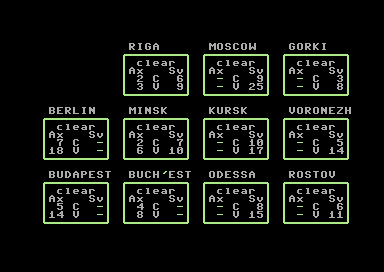
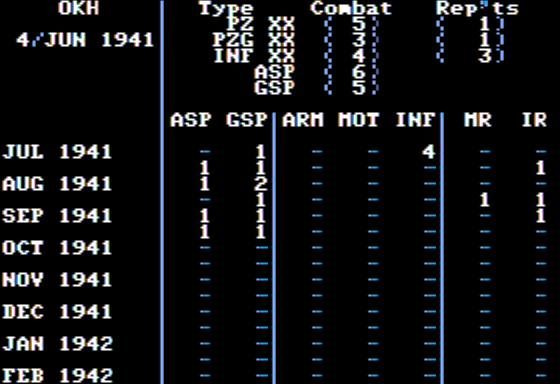
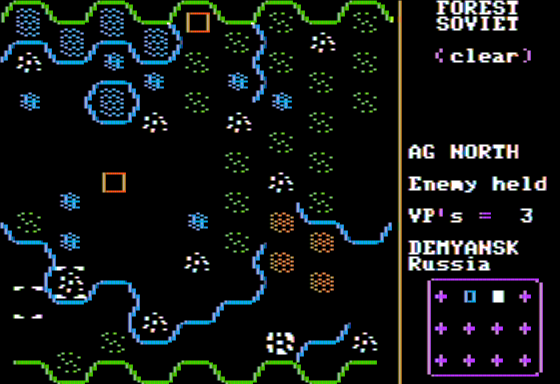
The game uses a top-down strategic view built around a hex-based battlefield. Its important visual task is tracking armies and their movement across a huge front, not depicting individual combat up close.
Story
There is no need for a scripted tale when the subject is the Eastern Front from 1941 to 1945. The campaign’s narrative comes from the changing pressure of the war and from your choice to take command of either the German or Soviet side.
That broad historical frame gives your decisions weight. A rest order, a retreat, or a push toward an objective is not a detached puzzle move; it becomes part of a campaign measured in years rather than a single battle’s afternoon.
The shorter Army Group scenarios tell smaller chapters of that same conflict. They are not just tutorials in disguise: by narrowing the map to North, Centre, or South, they make it easier to focus on one front’s problems without losing the game’s high-command perspective. For background on the game itself, see this history of Russia: The Great War in the East 1941–1945.
Overall Experience
Russia: The Great War in the East 1941-1945 is for the gamer who enjoys making a plan and accepting that subordinate formations will carry it out imperfectly. Its central idea remains compelling: command intent matters more than counter-by-counter busywork.
The price of that focus is a learning curve and occasional loss of direct control. If you come in expecting a tactical wargame where every corps obeys your hand exactly, the computer-controlled movement can feel restrictive. If you accept the role of high command, it becomes the feature that keeps the enormous campaign from turning into exhausting administration.
Start with one of the regional scenarios, learn to balance objectives, stances, and support, then decide whether you want the full 47-turn commitment. For patient strategy fans, the payoff is a rare kind of World War II game: one that asks you to manage the shape of a war, not merely win its next fight.

Reviews
There are no reviews yet.