 Retro Replay Retro Gaming History, Reviews & Emulation


Retro Replay Review
Gameplay
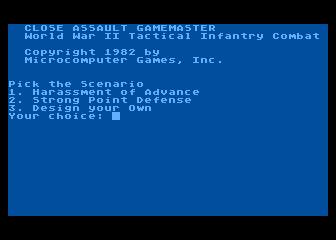
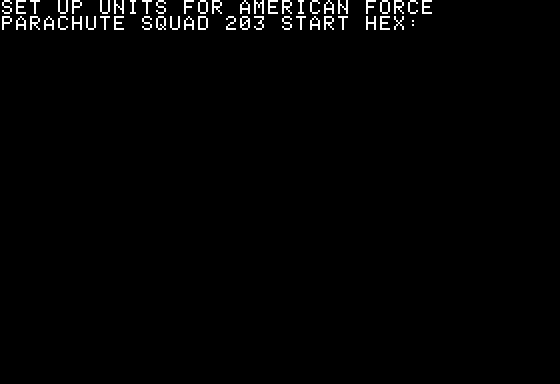
The first hour of Close Assault is likely to feel more like learning a compact tabletop wargame than settling into a conventional computer strategy game. Commands are entered as numbers or single letters at computer prompts, then you return to the board and counters to see what your choices have set in motion. Each turn represents two minutes and runs through six phases of movement, firing, and reactions. It is methodical, but the pace suits a game where one poorly judged advance can matter.
What makes the system interesting is how firmly it withholds certainty. Enemy units only appear when your side spots them. Their morale is inferred from what they do, not read from a convenient marker, and you must learn success odds through experience rather than consulting a transparent formula. That can frustrate anyone who wants clean tactical math, especially early on. For a wargamer willing to make an educated guess and live with it, though, it creates real pressure: you are deciding with imperfect battlefield knowledge, not solving an open-book puzzle.
The physical-computer split is more than a novelty. The board carries the small village and its three elevation levels, while the computer tracks the individual soldiers and resolves the hidden consequences of combat. Counters may disappear as squads are spotted, routed, or destroyed; demoralized units and units in close combat can leave your direct control entirely. The squad record pad also asks you to track casualties, equipment, experience, and leader placement. It is a lot to manage, but that friction helps each squad feel less disposable.
The commander number on that record pad is a particularly smart touch. You are represented on the battlefield, and if you become a casualty, the computer takes over and finishes the scenario while you watch. That turns careful leader placement into something more personal than an abstract efficiency choice. Leave your sergeants in sound positions and your force may still prevail; neglect that responsibility and you can become a spectator to the consequences.
Three scenarios and three forces yield a dozen historical situations across northern Europe, which is respectable variety for such a focused squad-level design. Hot-seat play fits the board-game roots naturally, while solitaire play lets the computer handle an opponent across multiple turns, including differences in equipment, morale, and tactics among the historical forces. The best fit is someone who enjoys taking notes, learning procedures, and accepting that a battle can go wrong without immediately revealing why.

Graphics
The main battlefield is a physical board: a small village laid over three levels of terrain, populated with cardboard counters. Rather than drawing a detailed battlefield on the computer, Close Assault puts the terrain and unit positions in front of you on the table and uses the screen for prompts and results. That makes the action tactile and easy to survey if you already enjoy traditional counters-and-map wargames.

Story
Close Assault does not chase a character-led campaign story. Its drama comes from historically grounded World War II situations in northern Europe, each built around the immediate problem in front of your command: locate the enemy, preserve cohesion, and decide when a risky attack is worth making.
The game’s strongest narrative tool is hidden information. A unit that has not been spotted is not merely an absent counter; it is a threat you have to account for. Morale likewise emerges through behavior, so the story of a battle is told in retreats, failures to hold, and sudden losses of control rather than in explanatory text.
Your own possible casualty gives that battlefield story an unusually direct stake. It is one thing to watch a squad break; it is another to know that your absence can hand the rest of the fight to the computer. That small rule turns a scenario into a commander’s account of incomplete knowledge, delegation, and consequences.
Overall Experience
At its best, Close Assault makes you feel like an armchair lieutenant with just enough information to be dangerous. It refuses the comfort of perfect odds and total command, then backs that philosophy with detailed soldier tracking and the possibility that your troops will slip beyond your control. The payoff is a rare kind of tension for a turn-based wargame: not just whether an attack works, but whether you ever understood the situation well enough to order it.
Its age is felt in the input method and the need to shuttle attention between computer, board, counters, and record pad. There is no escaping that this is a game for someone prepared to participate in the process. If you want fast turns or immediate clarity, the prompts and bookkeeping will feel like barriers. If setting up a map, recording squad details, and weighing uncertain reports sounds inviting, they are part of the pleasure.
The limited scenario count keeps it from becoming an endless war box, but the combination of three forces and a dozen represented situations gives the design more life than that number first suggests. More importantly, the different national characteristics give solitaire battles a reason not to feel interchangeable. Close Assault is a strong recommendation for patient historical-wargame fans who value fog of war over convenience and want a computer to enforce the things tabletop opponents normally know too easily.


Reviews
There are no reviews yet.