 Retro Replay Retro Gaming History, Reviews & Emulation
Retro Replay Review
Gameplay
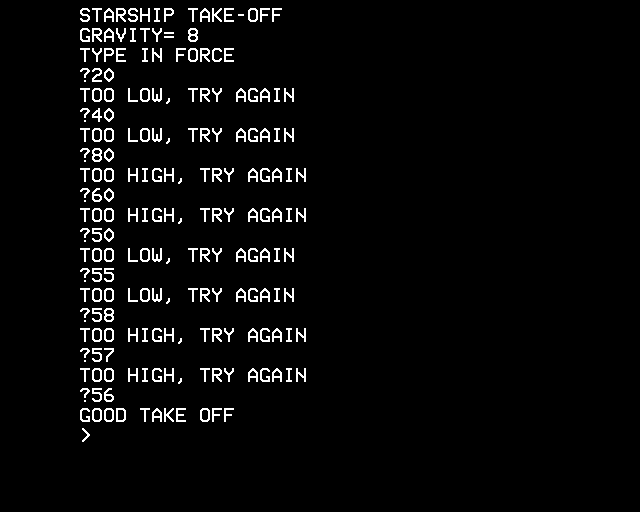
The first hour with Computer Spacegames has the pleasingly unruly feel of opening a toy box. The games are short, direct challenges built around one central idea, and the collection moves fast enough that a dud rarely holds you hostage. Starship Takeoff asks you to judge thrust against a reported gravity value in ten attempts, while Moonlander makes each fuel decision matter as altitude, speed, and remaining fuel tick down. They are modest exercises, but there is real tension in watching a landing go wrong because you were too cautious or too aggressive.
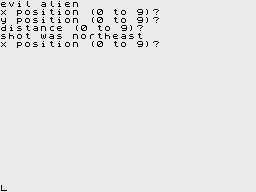
Its strongest material turns simple input into a test of thought. Intergalactic Games has you find the right launch angle and speed for a satellite, Evil Alien turns four last-chance bombs into a coordinate-and-distance guess, and Alien Snipers asks you to reason past deliberately false radar information. Beat the Bug Eyes and Asteroid Belt, by contrast, are quick reaction games: hit the key tied to the bug’s position or the number matching the stars on screen. That spread keeps the book lively, even when individual ideas are extremely bare-bones.
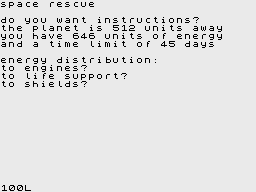
The more substantial detour is Space Mines. Keeping a colony alive for ten years by trading food, ore, and mines gives the compilation a welcome management game amid all the firing, calculating, and landing. Space Rescue also stands out because you must plan a ship’s trip before the character sleeps, then budget the energy left for landing. Not every game will land for every mood: Trip into the Future leans hard into calculation, and Death Valley‘s wall-avoiding flight challenge sounds punishing in the old-school way. But the collection’s brevity is its saving grace. If one exercise feels more like homework than fun, move on.
Graphics
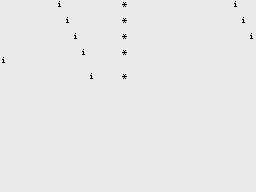
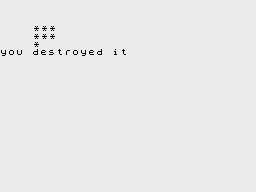
Most of these games live in a sparse, text-led world of letters, numbers, and tiny symbols. In Beat the Bug Eyes, the invading creatures are literally shown as “OO,” which tells you exactly how stripped-down the action is. Touchdown, the collection’s adaptation of Lunar Lander, is the exception with proper graphics, making it the clearest visual break from the book’s otherwise terminal-like screens.
Story
There is no long campaign tying these games together, and that is not really the point. Instead, each program opens with a clean pulp-space setup: escape a strange planet, broadcast the Intergalactic Games, hunt an invisible villain, survive a lunar descent, or face monsters from Galacticon. You understand the job immediately, then get to the numbers or keys that decide it.
The best scenarios give your calculations a little dramatic pressure. Spending fuel in Moonlander is not just subtracting a value when the alternative is slamming a lunar module into the ground. In Space Mines, buying and selling becomes easier to care about when the colony’s survival and satisfaction are attached to the decisions. These are tiny premises, but they do enough to keep the exercises from feeling completely abstract.
That simplicity also makes the anthology easy to dip into. You are never asked to remember a cast, follow a plot thread, or commit to a lengthy adventure. The recurring science-fiction language—aliens, satellites, asteroid fields, colonies, and future travel—acts as a friendly wrapper around programming-minded puzzles rather than an elaborate universe.
Overall Experience
Computer Spacegames earns its place as an educational game book because it does more than hand you a stack of finished diversions. It explains how the programs work, invites you to modify the code, and gives you problems to solve for each game. That changes the relationship: success is not only surviving a landing or beating a score, but also understanding why the program behaves as it does and seeing what happens when you alter it.
As pure entertainment, it is uneven by modern standards and often deliberately simple. Many challenges boil down to entering a guess, choosing a value, or pressing the right key at the right moment. Yet there is a real historical pleasure in that directness, especially because the compilation samples several kinds of early computer game design instead of repeating one formula thirteen times.
Give it a chance if you enjoy the hands-on ritual of type-in software, have patience for numerical puzzles, or want an approachable window into how young programmers learned by taking games apart. If you only want slick action, it will feel antique almost immediately. For the curious tinkerer, though, the payoff is bigger than any individual mini-game: you finish with a sense that these small programs are meant to be explored, changed, and made your own.


Reviews
There are no reviews yet.