 Retro Replay Retro Gaming History, Reviews & Emulation

Retro Replay Review
Gameplay
Computer Statis Pro Baseball starts by asking whether you actually want to manage a ballclub, not merely watch baseball-themed action happen. You set the lineup, take turns with another manager at the keyboard, and make calls one hitter at a time. The computer takes care of the board game’s chart work and bookkeeping, leaving you with the decisions that hurt: bring the infield in, issue the walk, pull a pitcher, send in a pinch hitter, or trust the player already on the field.
The strongest part is how often a seemingly modest choice carries a nasty amount of doubt. With the batting team making most of the calls, you are constantly weighing a bunt, sacrifice, steal, lead, or a more patient approach. A squeeze with two outs is blocked in the second edition, which is welcome protection against one particularly foolish impulse, but the game otherwise lets you own your strategy. When a gamble fails, there is no animation to blame and no controller fumble to hide behind. You made the call.
The player ratings give those choices weight instead of making them feel like generic menu selections. Batters are condensed into seven attributes, while pitchers also carry stamina that can build through good innings or collapse as trouble mounts. Season-based major-league player data, errors based on actual statistics, injuries, weather, and season stat tracking make a single game feel tied to a larger campaign. It is a deliberately cerebral rhythm, and it will frustrate anyone who wants to see every pitch, but it captures the uncomfortable second-guessing that makes managing baseball fun.
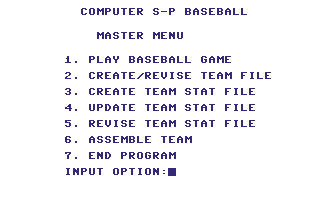
The interface sounds crowded because it is crowded: batting orders, player abilities, pitcher condition, the scoreboard, and a small field area all compete for room. Still, the single-key command menu is a sensible fit for a game with so many choices. Give it a little time and the information overload becomes the point—you are supposed to feel like the person responsible for everything.

Graphics
The game screen is built around information rather than ballpark drama. You see a packed management display with orders, ratings, pitcher status, the score, and a small section of field action. It is functional and dense, more like a manager’s desk covered in lineup cards than a televised game.
Do not come here for pitch-by-pitch visuals. The useful visual pleasure is in having the relevant baseball situation gathered on one screen, even if that crowded layout can make the opening innings feel intimidating.

Story
There is no scripted baseball tale pushing you from game to game. The story is the one you create through lineup choices, pitching decisions, slumps, mistakes, injuries, and the occasional weather interruption.
That makes the historical-team material especially inviting. Expansion disks let you manage historic teams and seasons, including Roger Maris and the 1919 “Black Sox,” turning the game into a chance to rewrite familiar baseball arguments from the manager’s chair.
Its drama comes from consequence rather than cutscenes. A pitcher who was cruising can suddenly become a problem; a cautious move can leave runs on the table; a daring one can become the decision you replay in your head. Baseball fans who enjoy that kind of self-inflicted narrative will find plenty to chew on.
Overall Experience
Computer Statis Pro Baseball is a persuasive computer conversion because it understands what should be automated and what should remain yours to agonize over. Calculations, card-style resolution, and season bookkeeping move into the computer, while the strategic calls remain front and center. That is a better use of the machine than simply trying to mimic a baseball broadcast.
Its age shows in the dense, text-heavy layout and the lack of on-field immediacy, so this is not the pick for a quick arcade-style baseball fix. You need patience for stats, menus, and a pace where tension is built from possibilities rather than constant motion. Once the ratings and situational decisions start to click, though, each at-bat has a sharp little pulse.
Give it a chance if you love tabletop sports simulations, historical rosters, or arguing over whether a manager should have gone for the steal. Skip it if you need direct control of every pitch and swing. For the right kind of baseball obsessive, it turns a home computer into a very effective dugout—and makes losing feel appropriately personal.


Reviews
There are no reviews yet.