 Retro Replay Retro Replay gaming reviews, news, emulation, geek stuff and more!
Retro Replay Review
Gameplay
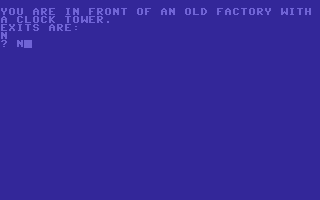
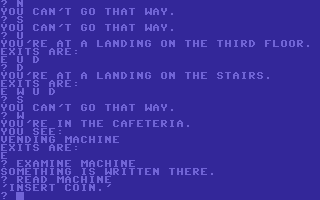
The first hour has the straightforward curiosity of an old-fashioned expedition. You are sent into a defunct factory tower to retrieve a piece of magnetic media, then immediately have to start treating every obstacle as a puzzle waiting for the right command or object. That modest goal works because it gives the exploration a purpose beyond simply wandering through rooms.
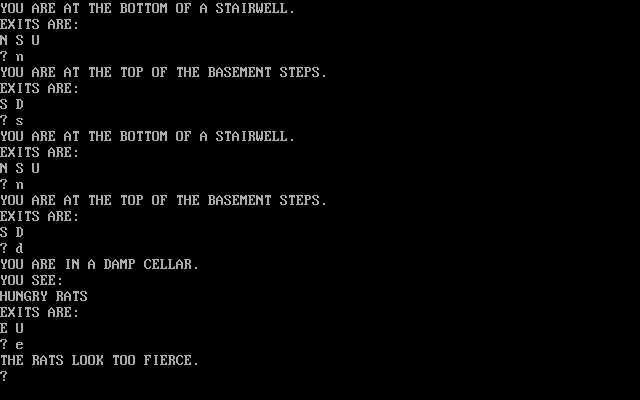
This is firmly in the classic text-adventure tradition: you inspect, experiment, collect clues from the environment, and solve standard adventure puzzles to push farther in. Vermin and small animals are not just decoration; they interfere with the job, so progress means figuring out how to overcome the next nuisance rather than merely locating the next exit. If you enjoy the slow click of realizing why an object matters, the game has the right kind of friction.
That same friction can turn into frustration if you want constant forward momentum. It comes from an era when patience, note-taking, and trying another line of thought were central to the fun. Give it a chance if you can enjoy a compact, old-school puzzle box and do not mind working for each breakthrough.
Graphics
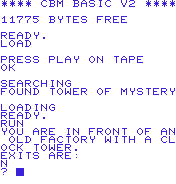
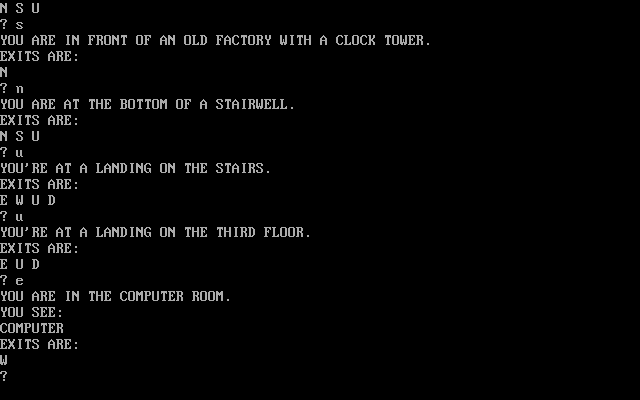
This is interactive fiction, so the factory tower, its pests, and the sought-after media exist in your imagination through text rather than illustrated scenes. The focus stays on reading descriptions and entering commands.
Story
Its best story idea is the mission itself: a game about recovering a copy of ADVENTURE, one of interactive fiction’s foundational works. That makes the quest feel like a playful bit of genre archaeology instead of a generic hunt for treasure.
The setting draws from a real factory building in Manchester, New Hampshire, which gives the tower a more grounded starting point than the usual fantasy cave or castle. You are still there for the puzzles first, but the abandoned industrial location is a welcome change of scenery for this kind of game.
Do not expect a character-driven tale or a pile of dramatic turns. The narrative is a clean frame for exploration: get into the tower, deal with what gets in your way, and retrieve the media. Its charm comes from that directness and from the historical wink at ADVENTURE.
Overall Experience
COMPUTE!’s Guide to Adventure Games’ included game is more interesting than a disposable tutorial extra because it lets you play a real, complete-feeling example of the form it is teaching. The goal is clear, the location has personality, and the puzzles put the lessons of text-adventure design into practice.
The source code is a major part of the appeal. Versions were included for Microsoft BASIC, Atari’s modified Microsoft BASIC, and TI BASIC, turning the game into something you can study alongside the book rather than only finish and set aside. For a curious beginner, seeing a playable adventure and its underlying program side by side is a rare kind of payoff.
As a game alone, it is a small, traditional adventure whose age shows in its demanding puzzle-first rhythm. As a learning artifact, it is much more compelling: you can play through the design decisions, then inspect how they were built. That combination makes it easy to recommend to retro-computing fans, aspiring BASIC tinkerers, and anyone with affection for the genre’s early, stubborn pleasures.


Reviews
There are no reviews yet.