 Retro Replay Retro Gaming History, Reviews & Emulation



Retro Replay Review
Gameplay
The first hour of Europe Ablaze is less about dramatic combat than accepting the burden of command. You can lead the broader campaign as Goering or Portal, establishing priorities and doctrines, or take the fleet commander’s seat and handle the practical mission planning. Either way, the game puts you in the uncomfortable position of making consequential decisions before you can be fully certain what the enemy intends. Sending aircraft out is easy; deciding which squadrons can afford the wear, which targets matter most, and where an interception might actually land is the real game.
Its most interesting idea is that planning is turn-based but the operational day keeps moving. You may halt the clock, inspect enemy strike plots, dispatch intercepts, and reinforce patrols in five-minute increments. That gives the game a welcome sense of pressure without turning it into a reflex test. When the pieces start clicking, you are not merely choosing missions; you are trying to keep a changing air war from slipping out of your hands as weather, timing, repairs, accidents, and enemy routes complicate every tidy plan.
Frustration is built into the design. After laying out a careful operation, you must often sit back and watch the outcome unfold, with the damage and lost aircraft ultimately reduced to a report. That can feel cold, especially if you want immediate feedback for every choice. Yet it is also where Europe Ablaze earns its tension: command means committing to a plan and discovering whether it survived contact with bad weather, tired squadrons, and an opponent who had plans of their own.
The flexible command structure is a serious asset. One person can run every role, the computer can handle parts of the war while you learn, and up to twelve people can divide the available roles in hot-seat play. The included map editor and Mediterranean scenario extend the game beyond its core Britain, France, and Germany campaigns. This is dense strategy rather than casual entertainment, but it has enough room for experimentation to reward a patient group or a solo player willing to learn by losing aircraft.

Graphics
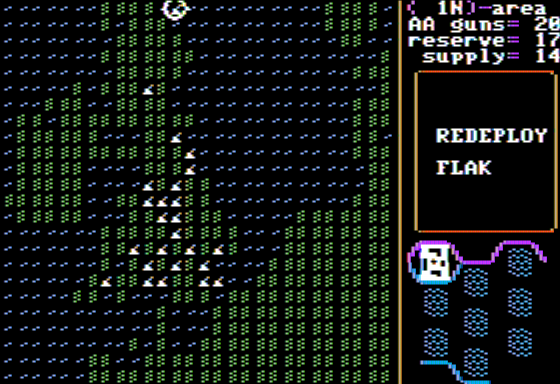
Europe Ablaze centers its action on a campaign-wide map, with short menu paths leading into command and report screens. Detailed hex maps lay out scenario targets for planning, while the moving clock shows the day’s operations progressing. The visuals are functional and information-focused: you spend your time reading the war’s shape, not admiring individual aircraft.

Story
There is no character-driven war story here. Europe Ablaze tells its World War II story through the accumulation of operational decisions: a raid ordered at the wrong time, a patrol strengthened before a strike arrives, aircraft lost, crews gaining experience, and damaged squadrons returning to service.
Taking command on either side gives the campaign a useful historical frame without pretending that you are a frontline ace. As Reichsmarschall Goering or Air Chief Marshal Portal, you are concerned with the fate of a nation’s air effort, and the day-end summaries make victory feel like an accounting of destruction delivered and resources spent.
That detached perspective will either draw you in or leave you cold. If you need named characters and scripted reversals, the reports will feel dry. If you can supply the drama yourself—the anxiety of committing a force and waiting to learn what came back—the campaign’s shifting weather, losses, repairs, and experience provide a convincing operational narrative.
Overall Experience
Europe Ablaze is a thoughtful, demanding simulation of responsibility rather than a game about immediate battlefield thrills. Its strongest moments come after you understand that every squadron assignment is a compromise. You cannot simply chase the best target; you must weigh readiness, aircraft suitability, flight paths, the enemy’s likely moves, and the larger campaign score.
The payoff is real for a strategy-minded World War II fan. The game’s runtime intervention system stops the campaign from becoming a completely hands-off calculation, while the independent fleet scores and commander-in-chief results make the larger chain of command matter. You can make a sound plan and still face a rough daily reckoning, which gives successes more weight than a cleanly predictable system would.
At 6.5, Europe Ablaze lands as a solid but specialized recommendation. Give it a chance if you enjoy hex-map planning, air-war logistics, and the uneasy wait for a command decision to bear fruit. Skip it if you want to directly fly missions or see every tactical clash play out in detail; this game is interested in the orders, the clock, and the report waiting at the end of the day.


Reviews
There are no reviews yet.