 Retro Replay Retro Gaming History, Reviews & Emulation


Retro Replay Review
Gameplay
The first route asks a simple question—can you get from one state to another by naming the next stop?—then immediately turns it into a race against the clock. You sit in the car, receive a start and end state, and type the states along the way. That is a more involving drill than merely pointing at a map because every incorrect state name costs time, while the trip itself accounts for travel time, time zones, and overnight stops.
What clicks is the way repetition becomes useful rather than purely rote. At first, you may be second-guessing which states border each other; after a few trips, the map starts to settle into your head. The optional time limit lets you decide whether this is a relaxed study session or a test of recall under pressure. Reaching the destination in time and earning that state’s thematic picture is a modest reward, but it gives a successful run a proper finish.
Play Capitals uses the same travel structure with capital names, so it is not a distinct new system so much as a tougher companion exercise. That can be frustrating if your state geography is solid but your capitals are rusty, since the keyboard demands exact knowledge at the moment you need it. Still, the practice mode matters: studying states and capitals before taking a timed route makes the game feel like it is teaching rather than simply catching you out.
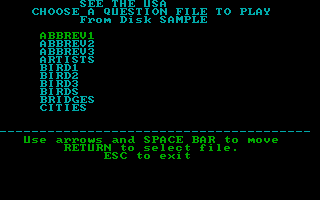
The quiz mode is the deeper well. Its subjects range from abbreviations, birds, flowers, mottos, and nicknames to history, landmarks, government, sports, waterways, and presidents. You answer by selecting the appropriate state after receiving a question. The breadth means you can move beyond bare map knowledge, though it also means the difficulty depends heavily on the theme you choose. If you enjoy old-school educational software that expects you to learn through repeated testing, See the U.S.A. has more staying power than its plain premise suggests.

Graphics
The central image is a map of the United States with every state laid out for study and play. That direct map view fits the route challenges well: you are working with locations rather than trying to picture them from a list of names.
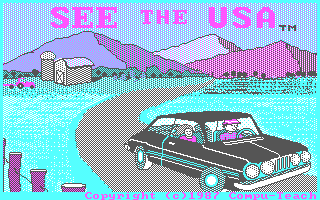
Finishing a route in time reveals a thematic picture for the destination state. It is a small visual prize, but one that breaks up the map-focused sessions and gives each completed journey a little character.

Story
There is no narrative campaign to carry you from one destination to the next. See the U.S.A. frames its progress as travel: you begin in one state or capital, work your way toward another, and try to arrive before time runs out.
That light road-trip framing is enough to make the routes feel more purposeful than a sheet of flash cards. The destination is always clear, and the journey is built from the geographic links you can recall under pressure.
The real subject is the country itself. Quiz questions spread across state facts, people, places, history, products, species, and regional details, making each correct answer part of a broader tour of U.S. knowledge rather than a detached trivia prompt.
Overall Experience
See the U.S.A. succeeds because it gives a dry subject a useful bit of urgency. The timed trips can expose holes in your geography quickly, and the keyboard-only input makes every answer feel deliberate. It will not charm you with elaborate game systems; it asks you to learn names, connections, and facts, then prove that you can retrieve them.
The payoff arrives gradually. A few sessions can turn a vague sense of where states are into practical route knowledge, while the capital mode and large quiz selection keep the learning from stopping at state borders. The penalty for wrong answers may wear on younger or less patient learners, particularly with a time limit active, but practice mode provides a sensible on-ramp.
Give it a chance if you want a focused geography refresher with enough trivia to expand beyond the map. It is especially worthwhile for anyone who enjoys testing themselves instead of being guided through lessons. For pure entertainment it is a limited ride; as a compact challenge that makes U.S. geography stick, it does its job well.



Reviews
There are no reviews yet.