 Retro Replay Retro Gaming History, Reviews & Emulation
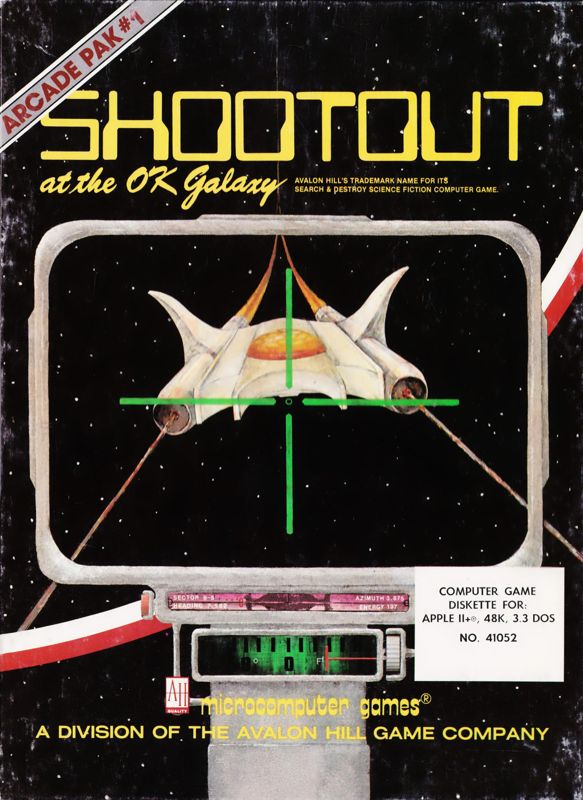


Retro Replay Review
Gameplay
The first few minutes make Shootout at the OK Galaxy seem almost generous. Your FSS Demona carries lasers capable of destroying a raider in one shot, and enemy fire initially does little more than nick the shields. Then the energy meter starts to matter. Lasers cost energy. Hyperspace costs energy. Reinforcing shields costs energy. Life support quietly spends it whether you are winning or wandering. Before long, a clean kill feels less important than whether you can still get back to the supply ship alive.
That pressure turns the dogfights into more than reflex shooting. Raiders maneuver, so you need to read their path, place them in the crosshairs, and fire where they are going rather than where they were. It is a simple idea, but it creates a nice moment of understanding when your shots stop chasing targets and start meeting them. Spraying rapid-fire lasers is tempting, especially when a raider refuses to cooperate, yet that panic response can leave the Demona short on the energy that actually keeps the patrol going.
Hyperspace travel adds another layer of discipline. Combat takes place in unlimited three-dimensional space, while jumps demand that the ship point along the galactic plane. You have to mind heading and azimuth instead of treating escape as a free button. The sector map, enemy readings, and supply-ship location make route planning part of the fight: scan, choose a threatened sector, finish the job, then calculate whether a detour for fuel is becoming mandatory.
The fifteen difficulty levels are meaningful because harder settings do not merely pile on danger. A faster life-support drain makes every delay costly, and occasional second raiders can turn a routine interception into a genuine risk. That is where the game becomes compelling for the right kind of player. You are not chasing a huge campaign of upgrades or scripted surprises; you are sharpening judgment under a steadily worsening clock.
Graphics
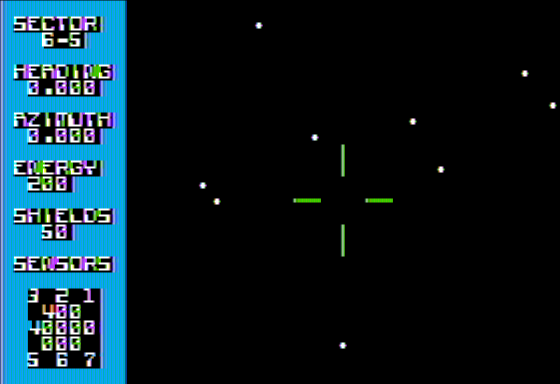
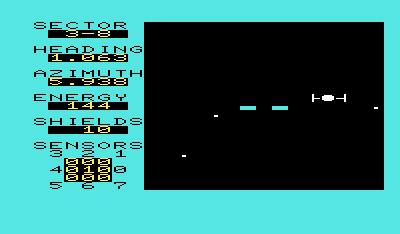
The main view is a starry void framed by crosshairs and packed instrument readouts for energy, shields, heading, azimuth, and sensors. It is sparse, but the layout puts the information you need in front of you while you line up a shot or prepare a jump.
Hyperspace has the game’s standout image: the stars vanish, then expand outward from a thin horizontal line as the Demona enters a new sector. The separate map gives scanned sectors and the vital supply ship a clear strategic view.

Story
There is not much ceremony before the mission. Billions of Federation citizens sit behind your patrol zone, barbarian starships are in front of it, and the Demona is the ship standing in between. That Western-flavored setup gives the title its character: this patch of space is your OK Corral, and every raider that slips past has consequences.
The story works mainly through the stakes attached to your decisions. Take too long clearing a zone and enemies reach the Federation’s populous planets. Burn through energy carelessly and the threat becomes personal, because the life-support system is draining right alongside your ammunition and mobility.
That stripped-down framing suits the game’s focus. You are not asked to manage a cast of characters or follow long stretches of dialogue. You are a patrol pilot trying to hold a line with a depleted fleet’s best ship, and the constant need to choose between aggression, safety, and resupply makes that role easy to inhabit.
Overall Experience
Shootout at the OK Galaxy earns its tension from scarcity. The raiders are dangerous because they are elusive and because they waste your time; the real enemy is the shared energy pool ticking away in the background. Once that relationship clicks, the game stops feeling like a basic shooter and starts feeling like a compact space-patrol simulation where every decision can create the next problem.
Frustration can set in when a target’s movement forces you to spend too long lining up a shot, or when you realize a fuel run has become urgent at the worst possible moment. Still, those setbacks are closely tied to the game’s central challenge rather than random cruelty. The supply ship is always a lifeline, but reaching it requires enough foresight to leave yourself gas for the trip and the alignment.
Give it a chance if you like old-school space combat with resource management at its core. Its lean structure will not suit anyone wanting constant spectacle or a broad progression loop, but its best moments are sharp: spotting a raider, leading the shot, making the kill, and seeing whether your remaining energy is enough to get home. For a game built around a single patrol ship and a hostile map, it finds a lot of suspense in a very small cockpit.


Reviews
There are no reviews yet.