 Retro Replay Retro Gaming History, Reviews & Emulation

Retro Replay Review
Gameplay
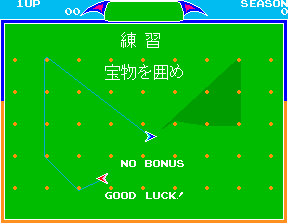
Libble Rabble earns its first few minutes on pure curiosity. Controlling two arrows joined by a string is strange enough that you have to recalibrate your instincts: you are not merely avoiding danger, but laying out a route that will wrap around the board’s poles and seal off a useful chunk of space. The moment your first enclosure snaps shut around mushrooms, the central trick clicks. It is direct, clean arcade problem-solving with a wonderfully physical sense of cause and effect.
That simplicity hides a mean little spatial puzzle. Every stage asks you to enclose all of its mushrooms, but the poles force you to think about the shape and length of your route. A greedy loop can leave an awkward mushroom behind; an overcautious route gives enemies more time to interfere. Since contact with an arrow costs a life, you must keep an eye on both ends of the string rather than tunnel-visioning on the enclosure you want to make.
The string-cutting enemies are where the pressure becomes properly nasty. They can disrupt an enclosure in progress, turning what looked like a safe plan into a scramble. Treasure chests give you a tempting reason to take additional risks, since cutting them out can add time and award other bonuses. That push and pull is the game’s strongest quality: play efficiently for the clear, or chase a chest and gamble that your route will hold together. If you enjoy score-minded arcade games that demand quick judgment more than elaborate rules, this is a sharp, distinctive one.
Graphics
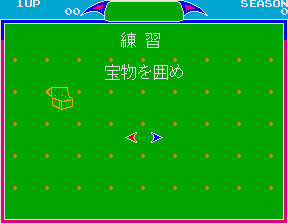
The action is viewed from above on single-screen boards, where the arrows, connecting string, evenly arranged poles, mushrooms, enemies, and treasure chests all share the same playfield. That layout makes the important information easy to track: you can see the path your string is forming and the enemies threatening either arrow at a glance.
Story
Libble Rabble frames its action as a succession of self-contained arcade challenges. Each board gives you a clear objective—trap the mushrooms in enclosed, cut-out areas—and lets the danger of the current layout create its own momentum.
That bare-bones setup suits the game. There is no need to pause the action for a larger dramatic detour when the interesting question is whether you can thread the arrows around the next set of poles before an enemy reaches you.
What you remember is not a plot twist but the shape of a comeback: a chest spotted in the middle of a dangerous route, a nearly ruined loop, and the relief of finally closing the board. The stakes are arcade stakes, but they are immediate.
Overall Experience
Libble Rabble is more than a Qix-like territory-cutter with a quirky controller idea. The two-ended string changes the rhythm from freeform carving into route planning under pressure, and that distinction gives the game its own identity. Its boards are compact, its goal is plain, and its tension arrives quickly.
Frustration can set in when an enemy hits an arrow or cuts the string just as a carefully planned enclosure is about to close. Still, that cruelty is tied directly to the decisions you are making, not to a complicated system you need to memorize. With practice, you start reading the poles, mushrooms, enemy positions, and chest opportunities as one interconnected problem.
Give it a chance if you like old-school arcade games that reward repeated attempts and cleaner execution. The payoff is the growing confidence to turn a cluttered board into a route you can see before you move. For game-specific release history, Libble Rabble’s history is useful context, but the reason to play is still that unusual string mechanic.


Reviews
There are no reviews yet.