 Retro Replay Retro Gaming History, Reviews & Emulation

Retro Replay Review
Gameplay
Sinistar begins like a mining run and ends like a survival horror game played at full throttle. You fly freely through an asteroid field, firing at planetoids to release Sinisite crystals, gathering them, and turning them into the Sinibombs that are your only meaningful answer to Sinistar itself. That is a wonderfully compact arcade objective, because every quiet moment is really preparation for a crisis that is already on its way.
The tension comes from how many jobs compete for your attention. Workers are stealing the same crystals you need and delivering them to Sinistar’s construction, while faster Warriors harass you directly. You cannot simply sit at a productive planetoid, either: sustained fire yields more crystals, but reckless shooting can destroy the rock. It makes harvesting feel active rather than rote. You are always judging whether to grab one more crystal, chase a Worker, or break away before a Warrior turns the screen into a mess.
Then Sinistar wakes up, and the game cashes in all that pressure. It is faster than your ship, kills on contact, ignores lasers, and needs at least 13 direct Sinibomb hits. The bombs home in, but their tendency to collide with planetoids, enemies, and projectiles means carrying a pile of ammunition is not the same as landing a win. If you fail to finish the job quickly, Workers can repair damaged sections. That is harsh, but it gives the final confrontation a desperate, memorable rhythm.
Zone changes stop the game from settling into one comfortable pattern. Worker, Warrior, Planetoid, and Void Zones shift the emphasis toward their namesake threat or resource, and the Void Zone is especially mean because fewer planetoids means fewer chances to restock bombs. Later cycles push those differences harder. The scanner is essential practical help here, pointing out planetoids, enemies, and Sinistar amid the scrolling space.
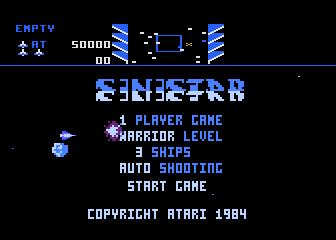
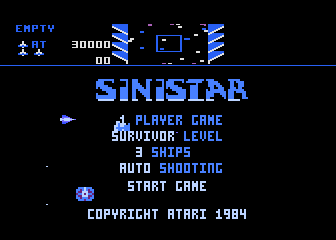
The arcade cabinet’s 49-position optical joystick is central to the original feel, letting you vary speed by how far you push it, with dedicated buttons for lasers and bombs. Two people can alternate turns, though not play simultaneously. On Atari 8-bit, selectable difficulty, starting lives, and automatic fire make the conversion more accommodating, but its enemies are less aggressive and its replacement speech briefly freezes play. That makes it an interesting home version, not the best expression of the game’s bite.
Graphics
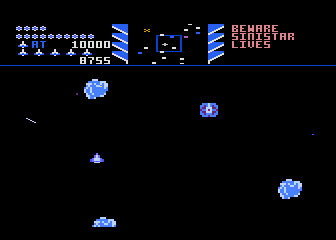
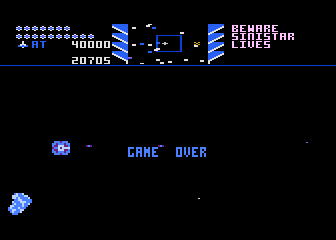
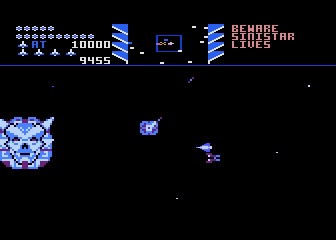
The action is viewed from above as your small spacecraft weaves through scrolling asteroid fields, planetoids, Workers, and Warriors. The scanner gives you a useful second read on the space around you, which matters once enemies and objectives pull in different directions. Sinistar’s completed appearance is the image that sticks: a huge enemy assembled piece by piece from the Workers’ deliveries, then suddenly loose on the same battlefield as your ship.
Story
There is barely a conventional story here, and that restraint works. The drama is told through play: enemy Workers are collecting material to construct Sinistar while you scramble to turn that same material into weapons. You understand the stakes immediately because you can watch the threat being built around you.
Sinistar’s arrival announcement gives that construction race a proper payoff. It is not merely another wave or a score target; it is the consequence of losing time, missing crystals, or failing to disrupt the Workers. The digitized speech in the arcade release gives the encounter its famous menace, turning an already dangerous pursuer into a genuine arcade boogeyman.
Each destruction sends you into another zone where the process begins again, so the fiction is less about a final resolution than an escalating series of encounters. That is enough for an arcade shooter. The game does not need lore when its central idea is so clear: mine the ammunition before the enemy finishes building the monster.
Overall Experience
Sinistar earns its reputation on focused pressure rather than depth for depth’s sake. Mining, enemy interference, limited ammunition, and a boss that demands accurate bomb use all lock together cleanly. The first hour can feel unforgiving, especially when a nearly complete Sinistar makes you realize you have underprepared, but learning to gather bombs with purpose is where the game starts to click.
Its age shows in its uncompromising arcade structure. You will repeat the same broad loop, and later zones intensify it instead of opening into something radically new. Yet the loop is strong because it asks for quick decisions under escalating threat, not blind endurance. A lost run usually leaves you knowing exactly what you should have done differently: mine more carefully, protect a key planetoid, interrupt the Workers, or save room to fire cleanly at Sinistar.
Give it a chance if you enjoy old shooters with a clear objective and enough hostility to make every resource matter. The arcade version is the recommendation, particularly if you can experience its original controls and speech. The Atari 8-bit version has value for its options and historical oddity, but the softer enemy behavior and speech pauses blunt the relentless momentum that makes Sinistar worth revisiting.


Reviews
There are no reviews yet.