 Retro Replay Retro Gaming History, Reviews & Emulation
Game Overview
Gameplay
Dig Dug starts as a straightforward monster hunt, then quietly turns into a compact game of territory control. You dig your own paths through the dirt, and that freedom is what makes each stage interesting. It is tempting to tunnel everywhere, but a sprawling network also gives enemies more ways to corner you. The strongest moments come when you pause long enough to plan a safe lane, draw a pursuer toward a rock, and turn a cramped section of earth into a trap.
The air pump makes close encounters tense in a way many old arcade attacks do not. You have to stand your ground and keep pumping long enough to burst an enemy, while knowing that stopping early lets it recover and come after you again. Pookas are relentless enough on their own, but Fygars force you to respect horizontal tunnels because their fire can end a run immediately. Once enemies begin slipping through dirt in ghostly form, hiding behind unexcavated ground stops being a reliable answer.
Rocks give the game its best risk-reward decisions. Dropping one can crush several enemies and earn a healthy bonus, but digging beneath it carelessly can get you flattened instead. The vegetables that appear after rocks have fallen add another reason to take chances, rather than simply clearing enemies one by one. Later stages speed the opposition up until your carefully laid routes can feel like a cage, which is exactly where Dig Dug becomes most exciting. It is brief, demanding arcade play with enough scoring wrinkles to make a better run feel achievable.
Graphics
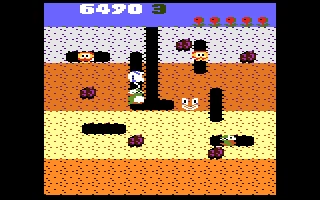
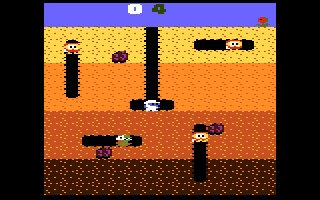
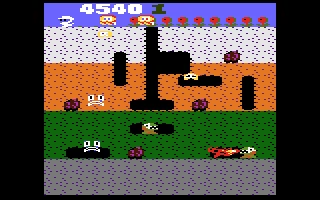
The Atari 7800 version uses chunky, low-detail sprites and broad bands of patterned soil in white, orange, green, and purple. Black tunnels cut sharply through those layers, so it is easy to see the routes you have opened and where a rock can drop. Pookas remain recognizable as small red, goggle-wearing round creatures, while Fygars read clearly as green dragons, though the characters are much cruder than the arcade game’s better-known look. The busy dirt patterns can make the screen feel a little harsh, but the distinct soil colors give deeper stages more visual variety.
Story
There is no real narrative to carry you forward. You are an underground digger clearing successive layers of Pookas and Fygars, and the game wisely puts all its energy into the next dangerous encounter rather than trying to dress that premise up.
Overall Experience
What keeps Dig Dug alive is how much consequence it packs into a single screen. You are not just shooting at enemies. You are making the battlefield with every step, then dealing with the enemies that use those same tunnels against you. That back-and-forth makes the game feel more thoughtful than its cute monsters and simple controls first suggest.
The Atari 7800 edition does not flatter the game with especially polished artwork, and anyone expecting a deep campaign will run out of new surprises quickly. Still, its rougher graphics do not get in the way of the central chase. The action remains clear, the stakes are immediate, and a bad decision is usually obvious enough that you want another try instead of blaming the game.
Give it a chance if you like arcade games built around repeat plays, score improvement, and learning how to stay calm when a safe tunnel suddenly is not safe anymore. If you need extensive modes, progression, or a story, it will feel slight. But if you can enjoy mastering a compact ruleset, Dig Dug remains a sharp little contest of nerve, timing, and tunnel placement.
Reviews
There are no reviews yet.