 Retro Replay Retro Gaming History, Reviews & Emulation
Retro Replay Review
Gameplay
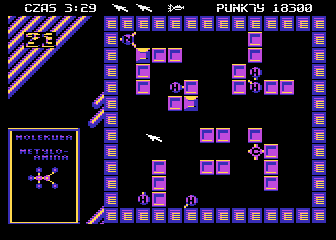
The first few moves in Atomia can catch you out because nothing politely stops where you want it to. Choose a direction and an element slides until it meets the board edge or another atom. That one rule turns each molecule into a small exercise in arranging blockers, predicting routes, and avoiding the one careless shove that leaves an atom stranded in the wrong lane.
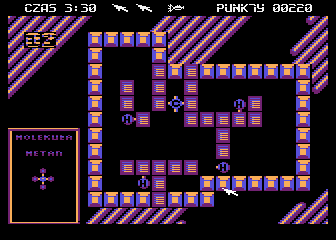
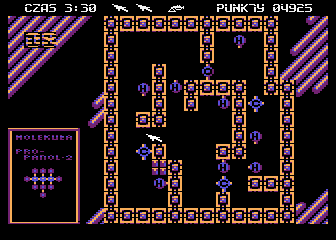
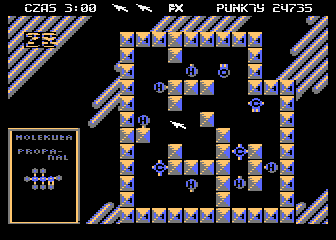
You are always working toward a predefined substance, with its name and construction pattern shown at the left of the screen. That gives every puzzle a concrete target instead of asking you to make a vague shape, and it helps the educational angle feel tied to the actual play. The better moments come when you stop treating atoms as individual pieces and start treating each placed atom as the stop that makes the next move possible.
The ticking time limit gives Atomia urgency, but it is also where frustration can set in. This is a game that asks for forethought, yet it pushes you to act before you have fully tested a route in your head. If you enjoy compact puzzles that reward efficient planning under pressure, that tension is part of the hook. If your favorite puzzle games let you patiently poke at a solution, Atomia can feel more demanding than its modest board layout suggests.
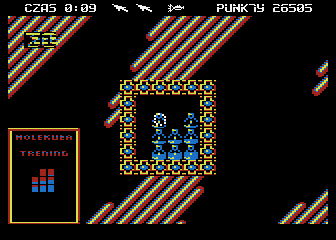
Every few levels, the focus shifts to arranging tubes with water correctly. These interruptions add some welcome variety across the 30-level run without abandoning the game’s science-class flavor. Atomia is not a huge puzzle epic, but its rules have enough bite to make a solved board feel earned.
Graphics
Atomia uses a top-down puzzle-board view, with the target substance’s name and pattern displayed along the left side while the atoms occupy the main play area. The layout keeps the goal in sight and makes it easy to judge where a moving atom will be stopped by another piece or the edge of the board.
Story
There is no elaborate narrative pulling you from level to level; the subject matter is the context. You are making named substances by arranging their constituent atoms into the shown pattern, which gives the puzzles a more specific purpose than abstract tile pushing.
That science framing works best as a prompt to think about construction and placement, not as a chemistry lesson with a lot of exposition. The molecule name and diagram tell you what you need to know before you begin working out the route.
The water-tube stages reinforce that classroom-puzzle tone by switching the arrangement task while staying within the same broad educational theme. It is light framing, but it is enough to keep the boards from feeling entirely disconnected.
Overall Experience
Atomia is a lean, old-school puzzle game built around one strong movement constraint. Sliding atoms until something stops them is easy to grasp and surprisingly awkward to master, especially once the clock makes every wrong idea costly. The game earns its best moments from that gap between knowing the destination and discovering the move order that can actually reach it.
Give it a chance if you like route-planning puzzles with a practical educational wrapper and do not mind being timed. The 30 levels make it a focused challenge rather than a long campaign, and the water-tube diversions help the structure avoid becoming too repetitive.
Its narrow scope is also its limitation. Atomia will not win over someone who needs a rich story or a sprawling set of systems, and impatient trial-and-error can collide badly with the timer. But for a gamer in the mood for concise boards, strict movement rules, and a little science-themed brainwork, it is a worthwhile curiosity.


Reviews
There are no reviews yet.