 Retro Replay Retro Gaming History, Reviews & Emulation

Retro Replay Review
Gameplay
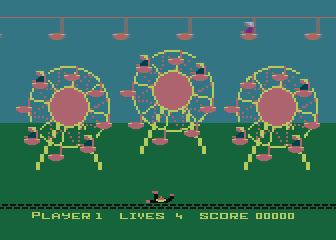
The first few minutes ask you to do two conflicting things at once: track where passengers will fall and keep an eye on Butcher Bill overhead. You stand beneath the ferris wheels, trying to catch victims as they drop while rocks rain down from his sky lift. It is simple in the way good early arcade games often are—easy to understand before the danger has properly piled up.
What starts to click is the value of positioning. You cannot just chase every falling passenger blindly when a rock can end your run. Saving at least six people is the immediate target, and clearing the wheels earns you a chance to shoot Bill. That brief shift from rescue work to retaliation is a welcome payoff, giving the frantic defensive play a clean sense of progress.
The roller-coaster section changes the cause of the chaos rather than reinventing the game. Ruthless Rick’s mines throw passengers from the cars, and you are back to catching them while Bill again throws stones. The repeated rules make it quick to learn, but they can also make the second half feel like an encore rather than a major escalation. The giant bouncing coil spring, triggered after too many missed passengers, is the real panic button: now you must jump while the rescue operation continues. It is harsh, but that harshness is where the game gets its teeth.
Graphics
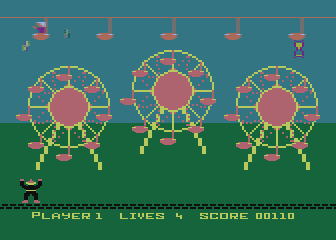
The carnival setting gives the action clear landmarks: ferris wheels above you, a roller coaster in the later section, and Butcher Bill riding across the action in a sky lift. Falling passengers, thrown rocks, mines, and the large bouncing spring make the danger easy to spot because each threat has a direct, urgent job on screen.
Story
This is not a narrative-heavy carnival adventure. Its story is a blunt arcade setup: Butcher Bill and Ruthless Rick turn a day at the fair into a murder spree, and Super Sam is the only person willing to intervene. The names are broad, pulpy, and perfectly suited to a game that wants you reacting before you have time to think.
The strongest touch is that the villains attack the rides and crowds instead of simply confronting you. You spend most of your time protecting passengers from the consequences of their sabotage, which gives the catching mechanic more urgency than a standard falling-object game.
There is also a pleasingly mean streak to the setup. Bill is not content to cause the accident from above; he actively throws rocks at the rescuer. Rick’s mines then turn the roller coaster into another emergency. It is thin material, but it keeps the action focused and gives each section a clear reason to exist.
Overall Experience
Carnival Massacre is a scrappy, tense little arcade game whose best moments come when you barely snatch a passenger out of the air and escape a rock at the same time. Its rescue premise creates instant stakes, and the requirement to save enough people before you can take a shot at Bill makes success feel earned.
Frustration will set in if you want generous recovery or lots of different challenges. Missing passengers can bring out the bouncing spring, and the roller-coaster stage intentionally returns to the same core demands. This is a game about repeating a narrow skill test until your reactions and positioning improve, not about steadily unveiling new systems.
Give it a chance if you enjoy compact arcade games that turn a single readable idea into a stressful high-score chase. The carnival theme and villainous setup are memorable, but the real reason to play is the split-second judgment: when to commit to a falling passenger, when to move away, and when surviving one more second matters more than playing hero.


Reviews
There are no reviews yet.