 Retro Replay Retro Gaming History, Reviews & Emulation

Retro Replay Review
Gameplay
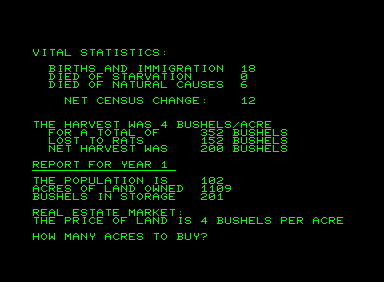
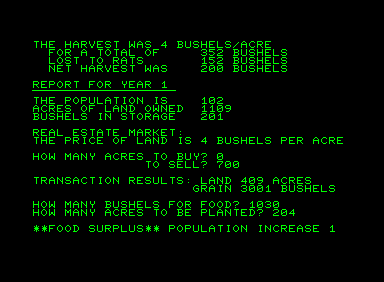
The first few turns of Kingdom put you in a familiar managerial squeeze with almost no padding around it. You buy or sell acres, decide how much grain your people receive, and commit grain to planting. That tiny list sounds dry until you realize each choice fights the others for the same stockpile. Feed everyone generously and you may not have enough to plant; invest hard in crops and you risk leaving the kingdom exposed.
What starts to click is the value of restraint. The goal is not simply to make every number as large as possible on the next turn. You need enough food to keep the realm functioning, enough seed to protect its future, and enough flexibility to react when chance intervenes. Random events are a meaningful source of tension rather than decorative noise because the game gives you so few levers to pull. A comfortable-looking plan can become a bad one in a hurry.
That economy of design also creates the main frustration. There is no broad toolbox to experiment with: your fortunes rest on land, food, planting, and the changing circumstances around them. When a run collapses, you may admire the harsh lesson or resent how little room you had to recover. It works best when you treat failure as part of learning the balance, not as a promise that every careful decision will be rewarded.
Graphics
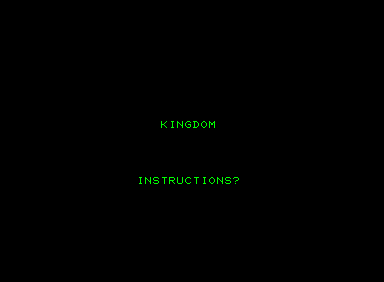
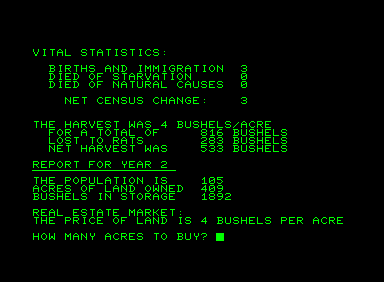
This is a text-based, menu-driven game built around its kingdom figures and turn-by-turn decisions. You spend your time reading the state of the realm and selecting options rather than watching characters, battles, or a detailed medieval world unfold on screen.

Story
Kingdom gives you a role rather than a plotted tale: you are the ruler of a medieval kingdom trying to guide it toward prosperity. That frame is enough to put some emotional weight behind the grain totals. Food is not merely a resource when the stated choice is how much of it to feed the people.
Its narrative is written through outcomes. Mismanage the kingdom and it falls into ruin; manage it well and the small realm can grow into a large empire. Those two endpoints give each turn a clear dramatic direction, even though the game’s real language is arithmetic and risk assessment.
Do not come in expecting a cast of characters or a chain of authored events. The story here is the one you make from a difficult run: the decision to hold grain back, the gamble on expansion, and the moment an unexpected event forces a new plan. For a game this compact, that is a fitting kind of drama.
Overall Experience
Kingdom is compelling because it refuses to hide the core problem of ruling behind excess systems. You are asked to make a few connected decisions with consequences that can compound over time. When your kingdom begins to stabilize and grow, that simplicity turns into satisfaction: you can see exactly which judgments got you there.
Its limits are equally plain. The narrow decision set means repetition arrives quickly, and the random events can make the experience feel severe rather than strategic when they disrupt a carefully measured turn. The game rewards a taste for replaying a compact scenario, adjusting your priorities, and seeing whether better judgment can overcome a rougher set of circumstances.
Give it a chance if you like old-school resource management stripped to its essential trade-offs. The payoff is not a lavish medieval adventure; it is the clean, slightly anxious pleasure of turning a vulnerable kingdom into a stronger one through patient decisions. That focus still has bite, even if the game’s simplicity leaves it better suited to short, thoughtful sessions than long campaigns.


Reviews
There are no reviews yet.