 Retro Replay Retro Gaming History, Reviews & Emulation
Retro Replay Review
Gameplay
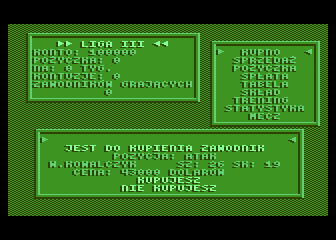
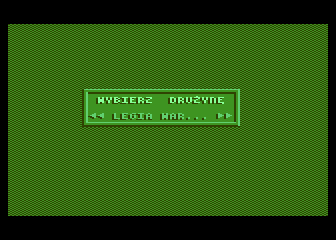
The first hour of Piłkarski Poker is about accepting how little stands between you and the consequences of your choices. You choose from 54 Polish clubs, but every route begins in the Polish Third Division. From there, the game puts the familiar manager responsibilities in your hands: select the team, decide on training, and enter the transfer market looking for a way forward.
Its best quality is that it does not bury those decisions under a huge web of systems. Basic player statistics and the league table give you enough information to make a case for changing the side or pursuing a transfer. You are not managing an endless collection of numbers; you are working with a stripped-down set of levers and trying to make them produce better results.
That simplicity also draws a hard line around the experience. The financial game is limited to ticket revenue, player transfers, and bank loans, so you will not find a deep club-economy puzzle here. Loans can still make a decision feel risky, especially when you are trying to improve a squad without much room for mistakes, but the management loop is plainly built for quick judgment rather than exhaustive planning.
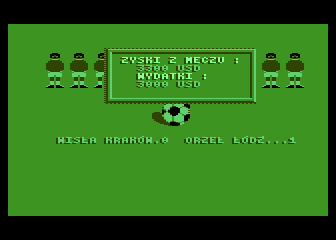
Match days are the biggest dividing line. A match is shown only through its actual score, so you cannot watch your team carry out the plan you assembled. For some, that makes the season move briskly and keeps the focus on the managerial choices. For others, the absence of on-field action will turn wins and losses into numbers that are harder to emotionally own.
Graphics
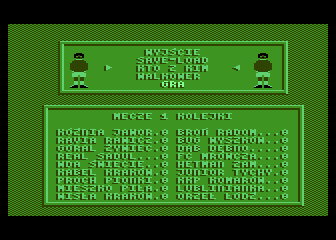
There are no football matches to watch: the match view is limited to the current score. The useful visual information lies in the basic player statistics and league table, which fit the game’s no-frills management focus but offer little match-day atmosphere.
Story
Piłkarski Poker does not tell a scripted football story. Its story is the one you make from a low-division start: whether your club can climb, whether a transfer pays off, and whether a loan becomes a lifeline or a bad bet.
That can be enough if you enjoy supplying the drama yourself. A changed lineup, a better league position, or a carefully chosen signing becomes meaningful because the game leaves room for you to connect the dots between decision and result.
Still, the narrative payoff depends heavily on your interest in the table. With results delivered as scores rather than depicted matches, the game asks you to care about the season’s arc without giving you much moment-to-moment theatre. It is a dry but honest approach to club management.
Overall Experience
Piłkarski Poker is a small, focused football management game with a pleasingly direct premise: take a Polish club from the Third Division and make smarter calls than the competition. It gets to the transfers, selection, training, and standings quickly, which gives it a clean rhythm.
The trade-off is clear. Basic statistics and a limited financial model leave less to dig into than in a deep management simulation, and score-only matches remove the emotional spark that makes many football games memorable. Frustration is most likely to set in when you want a result to tell you more than whether you won, lost, or drew.
Give it a chance if you like compact retro management games and find satisfaction in moving a club through a league table one decision at a time. Skip it if watching football, shaping tactics during a match, or running a detailed club economy is essential. Its payoff is modest, but its narrow focus can still be satisfying when you want football management reduced to its bare essentials.


Reviews
There are no reviews yet.