 Retro Replay Retro Gaming History, Reviews & Emulation
Retro Replay Review
Gameplay
Stellar Shuttle starts with a clean, immediately understandable problem: fly down through asteroids, land on Ttam, collect one refugee, then make it back to the mother ship. That one-at-a-time structure gives every successful pickup weight. You are not simply sweeping across the screen for points; once a passenger is aboard, the trip home becomes the part you cannot afford to botch.
The retro rockets are the heart of the tension. Slowing the shuttle sounds modest, but it turns asteroid navigation into a constant judgment call between control and momentum. Use them well and you can thread a difficult route with intention; use them late and you are left trying to salvage a bad approach. The game asks for careful flying rather than blind speed, which is exactly where its Lunar Rescue roots pay off.
The return to the mother ship gives the action a welcome shift. You gain a blaster to clear asteroids, while comets still demand that you maneuver quickly and drifting derelict ships need to be shot. Dragons entering from level two add another threat for the retro rockets to handle. That mix makes the upward leg more than a victory lap, though it can also be the point where a nearly completed rescue turns frustratingly sour.
Six refugees must be saved per level, one by one, so repetition is part of the deal. The scoring encourages you to care about more than survival: landings, safe returns, asteroids, derelicts, dragons, and each set of six rescues all contribute. Chasing a better score gives practiced runs extra purpose, but the real reward is learning how to make each dangerous flight look routine.
Graphics
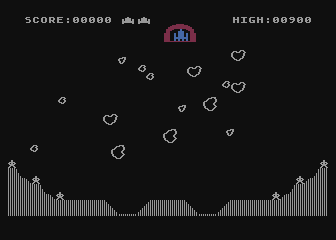
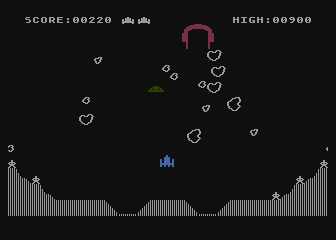
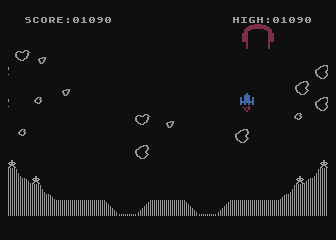
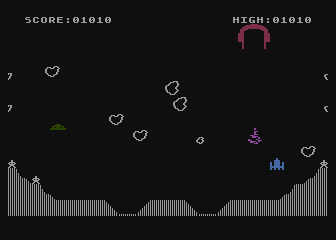
The side-view action keeps the shuttle, asteroid belt, planet surface, and mother ship in the same direct arcade frame. Asteroids, falling comets, dragons, and drifting derelict ships give the routes distinct hazards to watch, while the shuttle’s trips between Ttam and orbit make the rescue objective easy to read at a glance.
Story
The setup is brisk but effective: Ttam has drifted into an asteroid belt, and its people need to reach a mother ship outside the danger. It gives the repeated rescue loop a useful urgency without slowing the arcade action down.
Saving refugees individually is a smart fit for that premise. Each landing feels like a deliberate extraction, and every ascent carries the simple question of whether this particular passenger will make it out.
There is not much narrative beyond the evacuation, nor does there need to be. Dragons, comets, and derelicts function as escalating complications in a rescue mission that gets more hostile as you continue.
Overall Experience
Stellar Shuttle is at its best when you stop treating a rescue as a short trip and start planning the whole route: descent, landing, pickup, ascent, and the threats waiting near the mother ship. The controls’ speed-management angle gives it more bite than a straightforward shooter, and the changing danger on the return prevents the central loop from becoming completely automatic.
Its age shows in the uncompromising structure. You repeat the same essential objective six times to finish a level, and the challenge comes from performing it more reliably under pressure rather than from a broad range of activities. That can wear on you if you want constant novelty, but it is satisfying if you like an arcade game that demands composure and rewards improvement.
Give Stellar Shuttle a chance if precise, score-minded rescue action sounds better than a sprawling space adventure. Its payoff is the moment you can carry a refugee through a crowded route, slow at exactly the right time, clear a threat on the way back, and dock safely as though the asteroid belt never had a chance.


Reviews
There are no reviews yet.