 Retro Replay Retro Gaming History, Reviews & Emulation
Retro Replay Review
Gameplay
First Dominoes lives or dies on whether you enjoy the small decisions of classic dominoes, and it wisely does not get in the way of them. Every turn asks you to inspect the open ends on the table, match one with a tile from your hand, and consider what you are leaving available for everyone else. It is immediately understandable, but the first few rounds can still surprise you: a tile that clears your hand quickly may open exactly the number an opponent needs.
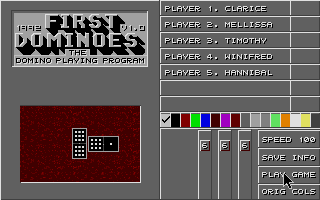
The double-nine set is a good fit for computer play. With more values in circulation, the board can grow into a wider problem than the compact games many people know from a standard double-six set. Playing against up to four computer opponents also changes the pace. A two-player game is direct and personal; fuller tables make it harder to keep track of which numbers may have been exhausted, and that uncertainty gives passing turns real tension.
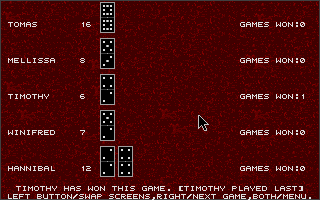
There is no flashy shortcut around a blocked hand. If none of your tiles matches an exposed end, you pass, and the table moves on without you. That can be frustrating when you are stuck holding a pile of high-pip tiles, but it is the right kind of frustration: it makes the next round’s hand management matter. When the board locks and nobody can play, the low total of remaining pips wins, so getting rid of awkward tiles is often as important as racing to empty your hand.
Its limits are also clear. This is dominoes presented as dominoes, with the whole experience built around repeated rounds rather than a changing set of challenges. Give it a chance if a clean board-game conversion sounds relaxing and you like extracting an edge from simple rules. If you need constant novelty or a big strategic campaign, the basic loop will run out of surprises quickly.

Graphics
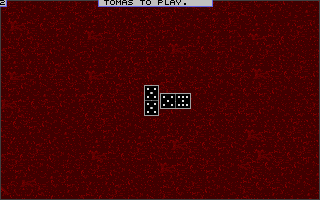
The top-down view is a sensible match for a tabletop game. You are looking at rectangular domino tiles and their numbered ends from the angle that matters, making the growing chain easy to inspect and the legal matches easy to spot.
Story
There is no narrative to carry First Dominoes from round to round. The tension comes from the state of the table: the open ends, the tiles you still hold, and the possibility that a pass will hand control to someone else.
That absence suits the material. A close round can still create its own tiny drama when the line finally closes and everyone counts the dots left in hand, but it is the sort of story you tell yourself through the result, not one the game stages for you.
As a result, you should not expect characters, a journey, or a larger reason to continue beyond the next match. The reward is simply seeing a sensible play work out, or realizing too late that an apparently safe tile let another opponent shed their last domino.
Overall Experience
First Dominoes is a modest but faithful solo-tabletop companion. It captures the part of dominoes that keeps a real game interesting: every placement is obvious in the moment, yet the consequences sit on the board for several turns. The computer opponents mean you can have a full table without assembling one, and the option for up to four of them gives the game more replay value than a fixed one-on-one match.
The payoff is quiet rather than dramatic. You will get the most from it in short sessions, especially if you like mentally tracking pips and trying to steer the available numbers before the board jams. It is less compelling as an all-evening game because the rules never expand beyond that core contest, but the core is sturdy.
For Atari ST owners who want a straightforward version of dominoes with several computer rivals, this is an easy recommendation. Everyone else should judge it by a simple question: does an uncluttered game of matching tiles, managing a hand, and winning blocked rounds sound satisfying? If it does, First Dominoes delivers exactly that with little fuss.



Reviews
There are no reviews yet.