 Retro Replay Retro Gaming History, Reviews & Emulation


Retro Replay Review
Gameplay
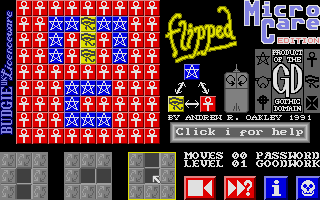
Flipped: Micro Care Edition starts with a rule set you can explain in seconds, then makes you respect it. Every board is a 9×9 grid whose tiles must all end on the same color. Clicking one of the three available 3×3 patterns and then placing it on the grid changes every affected tile: blue becomes yellow, yellow becomes red, and red becomes blue. That third color is the important wrinkle. You are not simply toggling between good and bad states; every move can help one color while knocking another further away.
The first few attempts are likely to be pleasantly messy. You will spot a block that looks wrong, drop a pattern over it, and immediately create a fresh problem beside it. Once the system clicks, you start thinking in cycles and coverage rather than individual corrections. A pattern placement is valuable not because it fixes a single patch, but because it advances several tiles toward the color you are trying to unify around.
The fixed set of three 3×3 patterns gives the game its personality. They force you to work with awkward shapes rather than freely paint the board into submission, so placement and timing matter. Frustration can set in when a nearly solved board still needs several setup moves before the final cleanup, but that is also where the puzzle earns its keep. If you enjoy working out a clean sequence from a small toolkit, the 100-level run has real staying power.

Graphics
The board is built around clear, flat tile colors: yellow, blue, and red across a 9×9 grid. The three 3×3 pattern choices sit below it, making it easy to compare a selected shape with the section of board you plan to change.
Story
Flipped: Micro Care Edition is structured as a sequence of 100 puzzle levels, not a plotted adventure. The board itself supplies the immediate context: take a mixed field of colors and find the sequence that leaves every tile matching.
That stripped-down approach suits the game. There is no need to decode an objective beyond what is right in front of you, and each solved level creates its own tiny before-and-after payoff.
As a result, the sense of progression comes from your growing command of the color cycle and pattern placement. If you need characters or a narrative reason to continue, this will feel bare; if you are happy letting the next stubborn grid be the motivation, it stays focused.
Overall Experience
This is a thoughtful, unhurried logic game that trusts you to sit with a problem. The lack of a time limit is more than a convenience: it lets you inspect the board, test your plan mentally, and take the satisfaction from solving it on your own terms instead of scrambling for speed.
Its best moments come when a board that first looked like a random scatter of colors suddenly becomes legible. You begin to see which tiles need one step through the color cycle, which need two, and where a 3×3 pattern can serve both groups. That change in perspective is the reward Flipped keeps offering.
Give it a chance if you want a pure tile puzzle with enough structure to punish impulsive clicks but no timer to turn thinking into stress. It is less suited to anyone looking for constant novelty or story-driven momentum, yet its concise rules and 100 boards make it a strong fit for methodical puzzle fans.


Reviews
There are no reviews yet.