 Retro Replay Retro Gaming History, Reviews & Emulation



Retro Replay Review
Gameplay
The first few turns of Battle 1917 are about reading the ground and deciding what you cannot afford to leave open. You are not simply trying to trade units efficiently; you are protecting a king that is both the weakest and slowest piece on the board. That chess-derived objective gives the match a sharp focus. One overextended attack can turn into a desperate defensive problem, and a quiet-looking route through the map can become the whole game.
The World War I roster keeps that familiar idea from feeling like ordinary chess. You command 29 pieces across infantry, cavalry, tanks, artillery and the king, with differing statistics pushing you to treat them differently. Tanks bring the era’s new technology into the conflict, while the mix of foot troops, mounted troops and guns asks you to think in terms of a broader battlefield than a compact chessboard. The result is accessible in purpose but tougher in practice: eliminating the opposing king sounds simple until both sides are covering routes and threatening counters.
Randomly generated 21-by-32 maps are the reason to come back. Wire, forests and rivers change the shape of each confrontation, so a plan that succeeds once cannot simply be repeated next game. That unpredictability is especially valuable in two-player play, where each new board gives both sides a fresh puzzle and a fresh set of traps to exploit. If you enjoy carefully calculated, turn-by-turn duels, Battle 1917 has a clean hook. If you want a sprawling war campaign, its single-minded king hunt may feel narrow.

Graphics
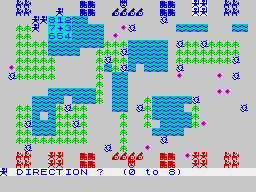
The game uses a top-down battlefield view built around a large square grid. Units share the board with forests, rivers and wire, and the straightforward layout suits a game where you need to judge lanes of movement and the safety of your king at a glance.
Story
Battle 1917 does not chase a character-driven World War I tale. Its story is the conflict that emerges from the board: a force trying to punch through terrain and enemy lines to reach a vulnerable commander before its own commander is cornered.
That stripped-down approach works because the historical setting changes the texture of the chess comparison. Cavalry, artillery and tanks place the contest in an era of shifting warfare, even though the victory condition remains deliberately abstract. You are not being led through a campaign of named battles; you are making the small, tense decisions that create your own battlefield narrative.
There is also something fitting about the lack of ornament. With the king as the sole decisive target, every sacrifice and every blocked path becomes easy to understand. The game’s drama comes from position, pressure and the moment you realize an enemy advance has become too dangerous to ignore.
Overall Experience
Battle 1917 is a compact strategy game with a strong central idea: take chess’s king hunt, expand the board, and filter it through a World War I unit roster. It will grab you quickly because the goal is so clear, then make you slow down once the terrain and varied units begin shaping your choices.
Its frustrations are tied to that same severity. The king’s weakness means mistakes can be punishing, and the game does not dilute its central contest with alternative objectives. Yet that hard edge is exactly what makes a well-defended breakthrough satisfying. You can learn more about the game’s history and 1983 release in this Battle 1917 reference.
Give it a chance if you want a short, cerebral two-player wargame where every turn can matter and every new map demands a new plan. The payoff is not spectacle or a sweeping campaign; it is the pleasure of spotting a route to the enemy king, committing to it, and hoping your own line holds long enough.



Reviews
There are no reviews yet.