 Retro Replay Retro Gaming History, Reviews & Emulation



Retro Replay Review
Gameplay
The first few minutes of Arcadia feel deceptively comfortable if you know Space Invaders-style shooters. Aliens cross a fixed screen, you fire upward, and trouble steadily comes down to meet you. Then the ship’s vertical movement changes the rhythm. Thrust lets you climb into open space, while releasing it sends you falling again, so you are constantly judging where you will be a second from now rather than simply sliding along a safe baseline.
That movement is more than a novelty. Enemy formations descend in varying patterns, shooting at you or trying to ram you, and the ability to rise gives you a real escape route—until it puts you directly in a worse position. The best moments come when you stop treating the screen as a firing gallery and start using its height: slipping past a formation, dropping away from an incoming threat, then lining up twin lasers on the way back.
The timed-wave rule is Arcadia‘s strongest idea. Each wave counts down from 99, and you only need to live until zero to move on. Wiping out a formation early brings in another one, while enemies left alive at the end dive hard toward the bottom. That creates a satisfying argument with yourself every round: take the points and invite fresh danger, or preserve your position and prepare for the final rush. It is a simple scoring gamble, but it gives the game more personality than a straightforward clear-the-screen shooter.
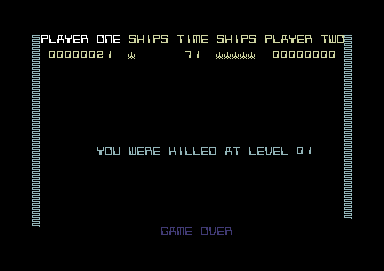
There is still a hard-edged early-1980s feel to it. The ZX Spectrum version’s row-based keyboard controls sound awkward because they are awkward; a joystick makes far more sense. The 2022 Windows version is the friendliest route, with controller support, remapping, and save states. Its extra lives every four completed waves offer a little breathing room, while the repeating level sequence means the long-term challenge is about improving your survival rather than reaching a grand finale.
Graphics
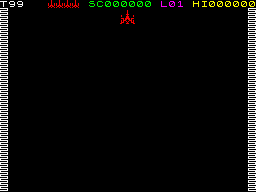
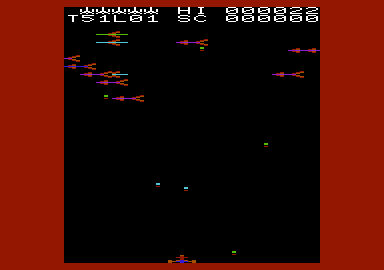
Arcadia keeps everything on one fixed battle screen: your small ship moves through alien formations that arrive in different shapes and patterns. The clear upward laser fire and the enemies’ eventual dives make the action easy to parse, even when the screen turns hostile.
Story
There is no narrative detour here. You are defending your ship against successive alien waves, and the game gets on with it immediately.
That bare setup suits the arcade structure. Each new formation functions as its own tiny crisis, defined by where the enemies move, whether they fire, and how aggressively they descend.
Do not come to Arcadia expecting characters, plot turns, or a final revelation after level twelve. Its drama is entirely player-made: the last seconds of a countdown, a formation you chose not to clear, and the scramble when those survivors dive.
Overall Experience
Arcadia is a modest but genuinely smart variation on the fixed-screen alien shooter. The freedom to move up and down adds a physical, slightly floaty sense of danger, and the countdown system prevents the usual “destroy everything as fast as possible” reflex from becoming the only sensible strategy.
Its limits are equally clear. The action remains a repeated cycle of waves, and the original twelve-level sequence eventually loops without becoming harder. If you need constant new ideas or a strong endpoint, that repetition will set in fast. The C64 edition offers more enemy types and selectable starting levels, while its alternating two-player option makes it the better fit for taking turns with someone nearby.
Give it a chance if you enjoy old arcade games that get extra mileage from one good rule change. At its best, Arcadia makes you balance greed against survival and turns a familiar alien attack into a compact game of nerve. It is not essential in the way the genre’s giants are, but its best trick remains worth experiencing.


Reviews
There are no reviews yet.