 Retro Replay Retro Gaming History, Reviews & Emulation
Retro Replay Review
Gameplay
Moondust opens with a wonderfully disorienting challenge: one joystick governs a space walker and six independent ships, all floating in different directions. You are not issuing crisp commands so much as applying pressure to a small fleet of stubborn objects. Everyone curves gradually toward a new heading, and the walker’s head can point where you want to go while its body lags behind. That disconnect is not a flaw to overcome; it is the whole game’s peculiar physical language.
Your job is to drop seeds away from the center, lure ships into them, and have those ships smear the seeds toward a circular target. It sounds simple in writing, yet it becomes a tense exercise in judging momentum, spacing, and risk. A seed spread close to the center earns a bullseye, extra points, and another seed, while a distant initial drop can raise the score further. The best moments come when an unruly ship finally carries a seed exactly where you hoped, turning what looked like an accident into a clean scoring play.
The frustration is deliberate and can be fierce. Ships near the screen edge become dizzy and briefly ignore you, collisions can knock out the walker, and later circles shrink while your seed supply is limited. There is no timer forcing rushed drops, which helps: take a beat, watch the drifting paths, and make a considered throw rather than feeding the chaos. Four play styles, including Spinsanity, add some variety, but the central test never changes: can you develop a feel for motion that initially feels almost hostile?
Graphics
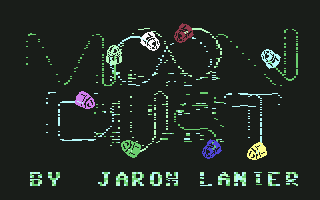
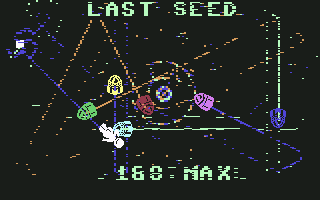
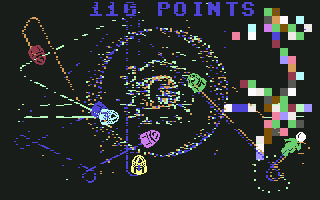
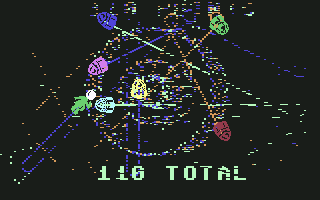
The action is shown in a spare top-down space screen: a space walker, six ships, a circular goal, and the seeds being spread across the field. That uncluttered layout matters because you need to track several drifting bodies at once. The walker changing color after knockouts also gives damage a clear on-screen reminder.

Story
Moondust does not build toward a conventional character tale or mission narrative. Its “story” is the small drama you create on each screen: releasing a seed, watching several ships converge or scatter, and trying to transform a messy flight pattern into a successful run at the target.
The game’s astral-procreation framing is appropriately odd. Seeds become the objects around which every decision turns, and progression means carrying enough of their smeared trails into the center circle. It gives the scoring loop a surreal purpose without getting in the way of the arcade play.
That abstraction suits the game. You will remember the sensation of barely recovering a seed run, or losing control near an edge, more than any plot beat. If you need a clear narrative hook, Moondust will feel remote; if you enjoy games that let motion itself carry the mood, its strange little space ritual has character.
Overall Experience
Moondust is a fascinating piece of arcade design because it asks you to stop expecting obedience from the controls. Once you accept that the ships are drifting partners rather than direct extensions of your hand, the game starts to click. Its difficulty comes from learning a shared momentum system, not merely reacting faster.
The generated soundtrack is a major part of that payoff. Blips and electronic tones shift with your movement and with the spreading seeds, so the screen’s confusion produces its own music. A successful round feels less like clearing a tidy puzzle and more like briefly conducting a machine that was trying to slip out of your grasp.
This is an easy recommendation for curious retro fans, especially if you enjoy eccentric experiments more than polished arcade certainty. It can absolutely irritate you when a ship refuses a command or a collision wrecks a promising attempt. Still, Moondust’s awkwardness is unusually purposeful, and mastering even a little of its drift makes its successes feel earned.


Reviews
There are no reviews yet.