 Retro Replay Retro Gaming History, Reviews & Emulation

Retro Replay Review
Gameplay
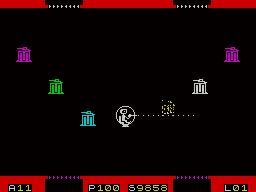
The Pyramid starts with an immediately understandable challenge, then makes you work for every safe decision. You move freely around each side-view chamber, but your shots only travel left or right. That limitation matters: aliens follow their own set patterns, so you are constantly lining up shots while finding room to dodge. It is direct, old-school shooting, and the first chambers invite you to learn by getting uncomfortably close to trouble.
The crystal system is the clever part. After you kill enough aliens, a crystal drops from above and changes from white to yellow to blue. White crystals can hurt you while destroying aliens, yellow ones are lost on contact with an alien, and only blue crystals can be collected. Suddenly, finishing the kill requirement is not the end of the room; it is the moment when the room becomes a small survival puzzle. You may need to let the crystal fall, avoid it, and protect it from enemies before you can use it.
Force fields at the exits turn those crystals into progress rather than a simple bonus. Since most levels require more than one, you cannot rush blindly toward a door after one successful pickup. The two-exit structure also gives each run a little uncertainty. Your route through the 120 chambers changes according to your choices, which is a stronger hook than a fixed sequence of arenas.
Frustration will come from the narrow shooting angle and the need to learn alien movement patterns chamber by chamber. Still, contact does not kill you outright: your shield absorbs damage until its energy runs dry. That forgiveness gives you room to recover from a bad position, though it does not erase the pressure of a room going wrong. If you enjoy arcade shooters that ask for patience as well as reflexes, the crystal timing makes this more interesting than a simple clear-the-screen exercise.

Graphics
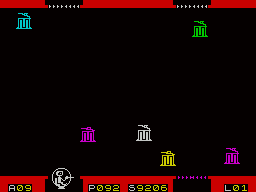
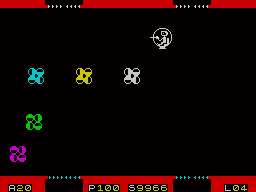
The action is shown from the side in single pyramid chambers, keeping the player, aliens, falling crystals, exits, and force fields in one focused play area. The crystal’s shift from white to yellow to blue is especially useful because its changing color tells you when it is dangerous, fragile, or ready to collect.
Story
There is no elaborate narrative pulling you through The Pyramid. You begin at the top of an alien-filled pyramid and fight your way down through fifteen levels toward the bottom. That is enough context for an arcade game built around rooms, exits, and survival.
The pyramid itself supplies the sense of progression. Every chamber is another contained obstacle, and every exit choice feels like a decision about how you will continue the descent. The goal is simple, but it fits the game’s compact structure.
Do not come here for characters or plot turns. The story is the run: preserving shield energy, handling the falling crystals, opening force fields, and seeing whether your chosen path gets you farther into the pyramid.
Overall Experience
The Pyramid has the kind of rules that sound strange for a minute and become satisfying once you play around them. The inability to shoot upward or downward, the patterned aliens, and the color-changing crystal all combine into a shooter where positioning matters as much as firing quickly.
Its route choices make repeat attempts more inviting than they would be in a strictly linear chamber shooter. With 120 chambers and 60 alien types, there is plenty of room for different enemy behaviors to test your ability to read a room before committing to a path.
This is a good fit if you like demanding early-1980s arcade design and can accept a game that expects you to learn through repeated attempts. The shield gives it a welcome margin for error, while the crystals keep every successful room from feeling routine. It is a modest but smart shooter whose best moments come when you turn a falling hazard into the key to your escape.


Reviews
There are no reviews yet.