 Retro Replay Retro Gaming History, Reviews & Emulation
Retro Replay Review
Gameplay
The first few possessions in Defense are likely to feel more like studying a sideline clipboard than playing a quick sports game. You are arranging players in rush, line, linebacker, and safety zones, deciding on formations, and then trying to stop a ball carrier with designated HIT keys as the play develops. That is a narrow slice of football, but it is handled with uncommon seriousness. Rather than asking you merely to react, Defense asks you to think about where the run is going before it gets there.
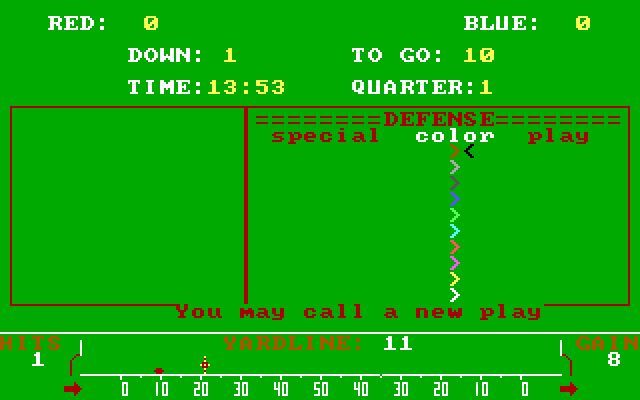
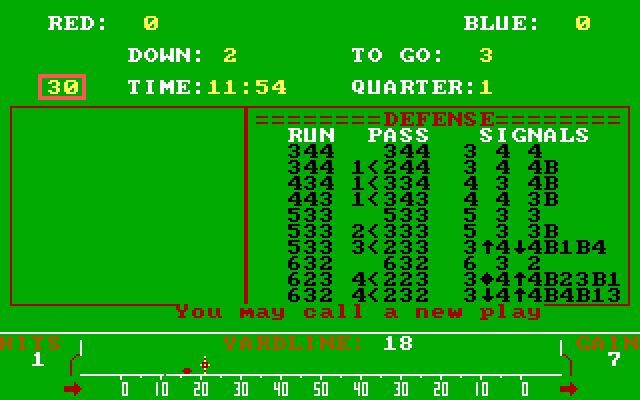
What starts to click is the relationship between preparation and execution. You can select offensive and defensive formations yourself or let the computer choose them automatically, which makes the game friendlier while you are still getting your bearings. Once you begin making the calls yourself, the tactical side has more bite: player disposition, rushing, blocking, movement, and tackles all matter. A stop feels earned because it came from a sensible setup followed by a timely response, not just a lucky button press.
The same commitment is also where frustration can set in. A top-down field broken into zones gives you a clear structure, yet it places a lot of responsibility on your understanding of the rules and your timing on the HIT keys. Defense does not sound interested in smoothing over that learning curve. The comprehensive instructions are not optional reading if you want to get beyond moving pieces around; they are part of the game’s bargain with you.
That bargain will land well if you enjoy old football games that care about tactics over polish. Two or four people can play together, and solo play against the computer gives you room to learn the system without needing a full group. It is not the sort of football game you fire up for instant spectacle. It is the sort you return to after a failed drive because you have an idea about how to set the defense differently next time.
Graphics
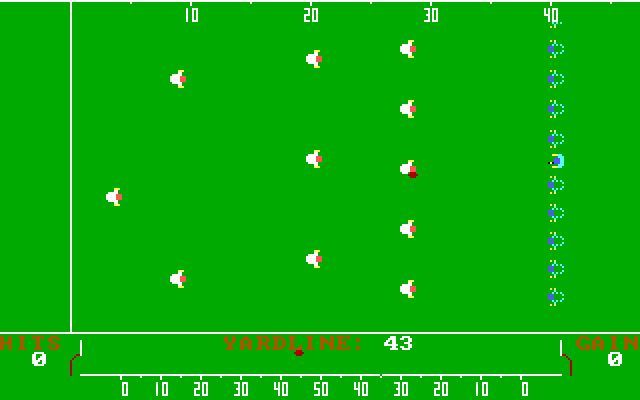
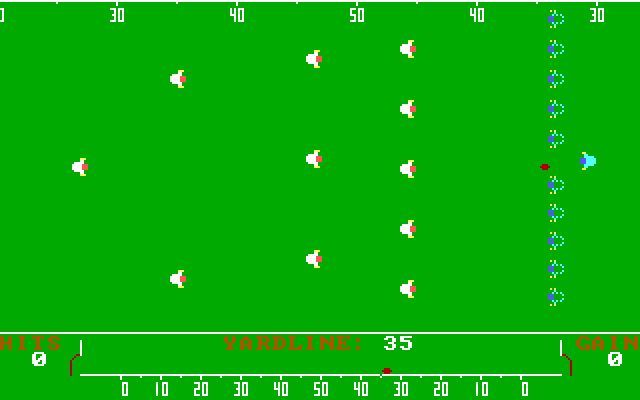
Defense uses a top-down field view, always moving left to right, with the computer team positioned on the left. The field is divided into labeled functional areas such as rush, line, linebacker, and safety zones, so you can see the spaces that matter when placing defenders and following a run. It is a practical board-like view built around tracking football positioning rather than dressing up the sport.
Story
Defense creates its own small football stories one possession at a time. The tension comes from an offense trying to carry the ball across the field while you anticipate the route, place the right people in the right zones, and wait for the moment to make a stop. A successful tackle becomes the end of a brief, readable sequence of decisions.
Because you control formations and player disposition, the drama has a personal edge. When your plan holds, you can point to the choices that made it work. When a ball carrier gets through, it is hard not to replay the setup in your head and wonder whether you committed too much to the rush or left a gap farther back.
That makes Defense more satisfying as a contest of adjustments than as a game chasing big individual moments. Its football narrative is built from field position, changing formations, and the recurring question of whether your read of the play was better than the other side’s. For tactically minded players, that is enough reason to keep another drive going.
Overall Experience
Defense is a specialized, thoughtful football game with a blunt name and an equally blunt mission: make the strategic work of American football playable. Its focus on formations, zones, tackles, and tactical instruction gives it a character that many broader sports games lack. You are asked to engage with football as a sequence of planned responses, not simply as a race toward the end zone.
The payoff is real, but it is aimed at a specific taste. If you enjoy learning a system, consulting documentation, and gradually recognizing why a defensive call succeeded or failed, Defense has satisfying substance. Its shareware roots and straightforward top-down design suit that patient, experimental rhythm.
Give it a chance if the phrase “realistic as opposed to pretty” sounds inviting rather than like a warning. You will get the most from it by treating the manual as a playbook, starting with computer-selected formations if needed, and then taking greater control as the zone system becomes familiar. For everyone else, the concentration it demands may outweigh the reward; for football tacticians, the reward is precisely that concentration.


Reviews
There are no reviews yet.