 Retro Replay Retro Replay gaming reviews, news, emulation, geek stuff and more!
Retro Replay Review
Gameplay
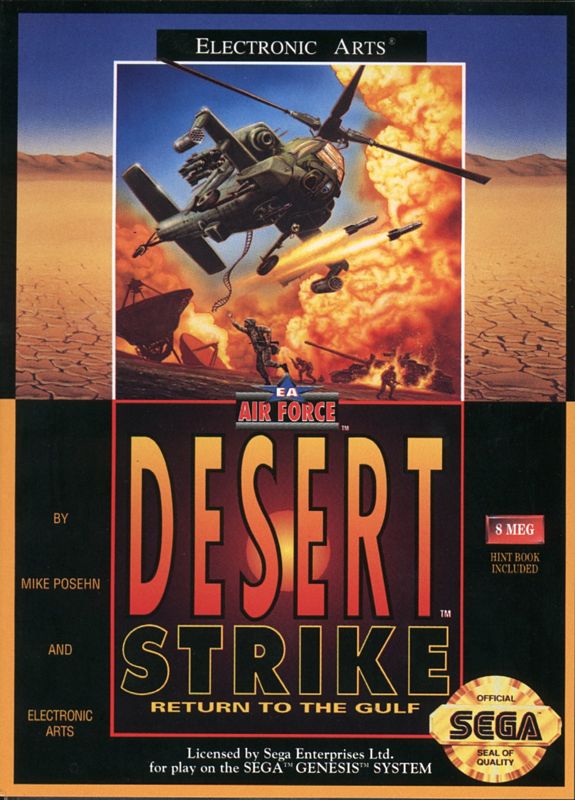
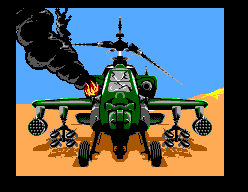
Desert Strike: Return to the Gulf delivers a tense blend of strategic planning and fast-paced action as you pilot an AH-64A Apache helicopter through a series of increasingly complex missions. From the moment you lift off in the isometric battlefield, you must juggle offensive strikes—using your machine gun and two tiers of missiles—with careful resource management. Fuel, armor, and ammo are all finite, so success often hinges on striking a balance between aggressive assaults on enemy positions and opportunistic scavenging of pickups scattered across the map.
(HEY YOU!! We hope you enjoy! We try not to run ads. So basically, this is a very expensive hobby running this site. Please consider joining us for updates, forums, and more. Network w/ us to make some cash or friends while retro gaming, and you can win some free retro games for posting. Okay, carry on 👍)
The mission variety keeps the experience from ever feeling repetitive. One sortie might task you with rescuing prisoners of war and MIA soldiers by landing in hostile territory, while the next has you taking out SCUD missile launchers, power plants, or heavily defended armor columns. Each objective feels distinct, and the requirement to ferry rescued soldiers back to a safe landing zone adds a satisfying risk-versus-reward dynamic, especially when your fuel gauge is inching toward empty.
Controls are surprisingly intuitive for an overhead, isometric shooter of its era. Your helicopter’s movement is responsive, and weapon swapping is straightforward, letting you switch between guns and missiles on the fly. Enemy anti-aircraft turrets, missile batteries, and tank patrols will force you to constantly adapt—ducking behind ridgelines, strafing hidden SAM sites, and timing your rocket volleys just right. While the learning curve can be steep for newcomers, veteran players will appreciate the depth and precision the mechanics afford.
Replay value stems from the branching tactical approaches you can adopt. Do you rush forward, eke out every rescue for extra armor, or do you play it safe, methodically neutralizing threats from a distance? Replay speeds, high-score chases, and the drive to complete every mission with a full load of pickups ensure that Desert Strike remains engaging long after the credits roll.
Graphics
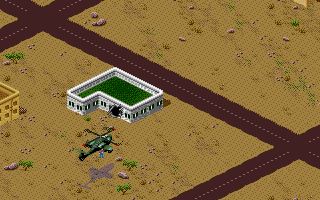
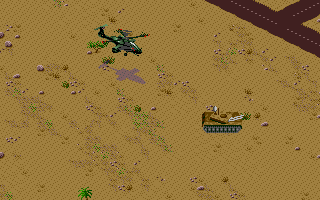
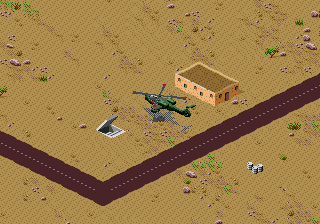
Visually, Desert Strike represents a high watermark for early ’90s console and PC shooters. The isometric perspective offers a clear tactical view of each mission area, where palm trees, desert dunes, and fortified bases are rendered in crisp, colorful sprites. While the hardware limitations mean the environments are somewhat blocky by modern standards, the level of detail in buildings, vehicles, and enemy emplacements remains impressive, even if you’re playing on a vintage Genesis or a retro-styled emulator.
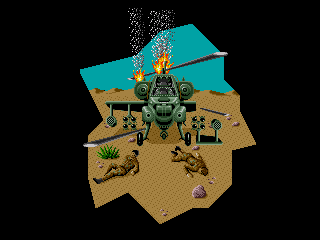
Enemy and ally units are easily distinguishable, thanks to smart use of color coding and sprite design. Apache rotors blur convincingly during flight, and missile trails and explosion animations—though simple—convey the thrill of combat. Night missions, introduced in later stages, showcase subtle palette shifts and occasional flares, heightening immersion as you navigate by radar and HUD indicators rather than bright daylight landmarks.
Performance is rock-solid across platforms. Frame rates rarely dip, even as dozens of projectiles and explosions clutter the screen. The HUD remains clean and informative, displaying fuel, armor, weapon loads, and mini-map cues without cluttering your view. When compared to contemporaries, Desert Strike’s balance of performance and visual flair holds up remarkably well.
While the game doesn’t boast 3D models or dynamic shadows, its hand-crafted environments and attention to animation detail give each mission a lived-in feel. For fans of retro aesthetics, the graphical style not only evokes the Gulf War theater but also reinforces the tension of each engagement.
Story
Set a year after the real-world Gulf War, Desert Strike crafts a scenario in which a rogue general named Kilbaba (Muababa in later versions) seizes control of a Middle Eastern emirate and threatens a nuclear strike on the West. The game’s premise taps into early ’90s post-conflict anxieties, grounding its fictional plot in recognizable geopolitics without becoming overly political. You assume the role of a top-secret pilot chosen by the U.S. President to dismantle Kilbaba’s war machine before tensions escalate into global catastrophe.
Briefing screens and in-game text snippets provide mission context, but it’s the urgency in the situation that drives the narrative momentum. Each assignment—you’re tasked with rescuing POWs, disabling SCUD missile sites, or annihilating enemy radar arrays—feels like a critical piece in a larger strategic puzzle. These transitions from one objective to the next maintain a flow that keeps you invested in the overarching effort to thwart a nuclear threat.
While character development is minimal and dialogue is sparse, the storytelling excels through scenario design and mission stakes. The looming specter of a world-ending missile launch infuses every checkpoint and casualty report with significance. By the final missions, your successes and failures carry palpable weight, making the eventual showdown with Kilbaba all the more satisfying.
If you’re looking for a deep, character-driven drama, Desert Strike may feel lean. However, for players who appreciate story delivered through gameplay and escalating objectives rather than lengthy cutscenes, the title strikes an effective balance between narrative and action.
Overall Experience
Desert Strike: Return to the Gulf succeeds as both an arcade-style action shooter and a strategic war game. Its tight controls, varied mission objectives, and resource-management mechanics create a compelling loop that rewards skillful flying and tactical planning. Even decades after its release, the core gameplay remains accessible yet challenging, making it a standout entry in the Strike series’ lineage.
The audiovisual presentation—while dated by today’s high-definition standards—retains a nostalgic charm and communicates all necessary information with clarity. The story backdrop, rooted in early ’90s geopolitics, offers a sense of authenticity without bogging down the pace. Meanwhile, the game’s difficulty curve and mission diversity ensure that both newcomers and seasoned veterans find reasons to return.
Desert Strike laid the groundwork for numerous sequels, but this inaugural title holds its own as a self-contained war simulation. Its emphasis on helicopter dynamics, combined with pickup-based survival mechanics and an isometric battlefield, feels uniquely engaging. Whether you’re chasing high scores or striving for a perfect run with full armor and fuel, the challenge is always just within reach.
For retro gamers, strategy fans, and action enthusiasts alike, Desert Strike: Return to the Gulf remains a must-play classic. Its blend of tactical depth, mission variety, and immersive Gulf War setting make it a timeless recommendation for anyone seeking a top-down combat experience with real stakes and rich replay value.


Reviews
There are no reviews yet.