 Retro Replay Retro Gaming History, Reviews & Emulation


Retro Replay Review
Gameplay
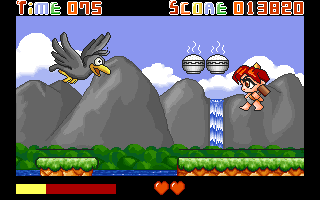
The first few stages make Dokkaebi-ga Ganda seem like a friendly, colorful platformer, then groups of enemies start turning ordinary jumps into tense little scrambles. They can rush your character and shove you from platforms, so simply advancing is not enough; you need to pick your moments, make space, and avoid getting crowded near an edge. That direct pressure is the game’s strongest idea.
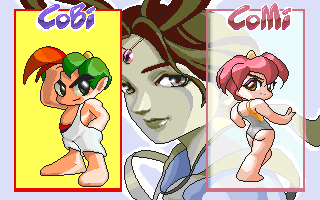
Cobi’s club and Comi’s hammer give you a choice of protagonist, but not a meaningful gameplay split: both control the same way and use the same special combo inputs. The combos are what keep combat from becoming pure button tapping, rewarding you for learning key combinations amid the chaos. Don’t go in expecting deep character specialization, but do give the moves time to settle in before deciding the fighting is too plain.
Stage progression is clean and traditional, moving through linear areas grouped around themes such as forests, caves, and villages, with every third stage ending in a boss battle. The collectible scatter is less satisfying. Coins, sushi, and blue flames from defeated enemies mainly inflate your score, while rice bowls are the pickups that matter because they restore health; a large bowl fully refills it. With death permanently cutting one heart from your overall health, you will quickly learn to value recovery items over score-chasing.
The selectable difficulty and zero-to-seven continue setting let you tune how unforgiving the run becomes. That matters because the health penalty gives mistakes real weight instead of treating every death as a brief reset. Pick more continues if you want to learn the combos and boss encounters without replaying as much; cut them down only if you want the harsher arcade-style challenge.
Graphics
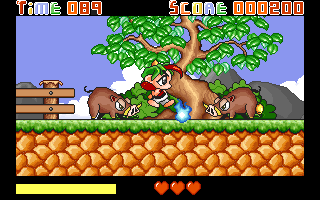
The game uses a colorful side-view look, with little kobold heroes crossing forest, cave, and village stages. Its themed locations give the linear route some welcome visual change, while the compact platform layouts keep enemies and dangerous edges easy to keep in view.
Story
Dokkaebi-ga Ganda keeps its focus on Cobi and Comi as playable kobold leads rather than building its hook around an elaborate narrative. You choose the boy or girl at the start, but their identical handling means the choice reads more as a preference for hero and weapon than a different perspective on events.
The journey through forests, caves, and villages gives the game a simple sense of movement from place to place. Boss stages arrive at the end of each three-stage theme, creating natural chapter breaks even when the action is doing more of the talking than the characters.
That light touch suits the game’s quick, stage-by-stage structure. If you want plot twists or character-driven payoff, this is not where the reward lies; the momentum comes from surviving the next enemy rush, reaching the next theme, and clearing its boss.
Overall Experience
Dokkaebi-ga Ganda is a modest but engaging action-platformer whose best moments come when its enemies force you to fight for footing. The combination attacks add a welcome layer beyond basic jumping and striking, and the permanent-health consequence makes successful runs feel earned.
Its rougher edge is the mismatch between plentiful collectibles and meaningful rewards. Most pickups do little besides raise a score, so exploration has less practical excitement than it first appears to promise. The health bowls stand out precisely because they affect your odds of surviving the run.
Give it a chance if you like 1990s platform games with linear stages, boss checkpoints, and a firm penalty for careless deaths. Cobi and Comi do not offer dramatically different ways to play, but the difficulty and continue settings let you find a comfortable entry point before deciding how much punishment you want. It is not a sprawling adventure, yet its focused combat-and-platforming loop has enough tension to make a determined playthrough worthwhile.


Reviews
There are no reviews yet.