 Retro Replay Retro Gaming History, Reviews & Emulation

Retro Replay Review
Gameplay
Flash Attack gets interesting the moment you realize that charging toward the enemy base is probably the fastest way to lose a tank. This is real-time warfare built around limited tools: five tanks over the course of a match, three ICBMs, finite shells, mines, walls, and fuel. Every trip across the map has a cost, so a cautious player can make an aggressive opponent pay dearly for bad movement.
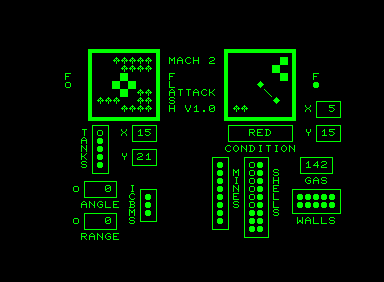
The split focus on your base and one active tank gives the game its tension. You can watch home while advancing, but you still have to decide where that single deployed tank is most useful. Do you probe for the enemy, lay a minefield, construct a wall, or preserve fuel for a quick retreat? Since mines are hidden from your opponent and walls can become fake bases, Flash Attack has room for genuinely sneaky play rather than straightforward tank trading.
The ICBMs are the feature that will either hook you or test your patience. You fire them by entering an angle and range, using the displayed coordinates of your base and tank to judge the shot. Landing one should feel earned because it asks you to estimate rather than hand you an automatic lock-on. It also means a rushed calculation can waste one of only three missiles, which is a harsh but fitting consequence in a game so committed to resource pressure.
That deliberate, number-conscious style is not for everyone. If you want immediate arcade tank combat, the fuel management and coordinate-based missile firing may feel like work before they feel satisfying. Give it a few rounds, though, and the restrictions start to connect: a fake base can draw attention, a mine can punish pursuit, and a well-placed tank can create an opening for a missile strike.
Graphics
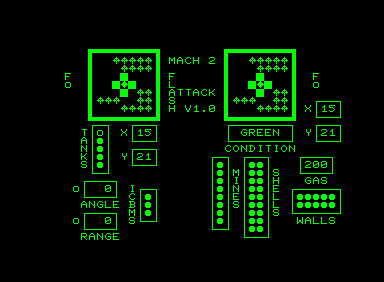
The action is shown from above, with separate views keeping your base and active tank in sight. That top-down battlefield view suits the game’s practical needs: you can track terrain, judge a tank’s route, and keep an eye on the place you cannot afford to leave undefended.
Story
Flash Attack frames its conflict as modern warfare between two opposing bases, and it wisely keeps the stakes immediate. Your objective is not buried beneath a long setup: destroy the other side’s base before they do the same to yours.
What passes for drama comes from the match itself. A tank disappearing into the terrain, the threat of an unseen mine, and the possibility that a wall is disguising a decoy base give each confrontation a small war-game narrative of bluffing and counterbluffing.
The strongest stories here are the ones you create with another person. A missile that lands after careful coordinate work or a trap that catches an overconfident advance will be more memorable than any scripted scenario could be.
Overall Experience
Flash Attack is a compact strategy duel with more nerve than its basic tank-and-base premise suggests. The multi-machine multiplayer setup is a particularly distinctive fit for a competitive game built around secrecy: each side can make plans without sharing the same screen. A single-machine option is also there, but the game’s best qualities clearly come alive when another human is trying to fool you.
Its age shows in how directly it asks you to handle distance, ammunition, fuel, and missile calculations, yet that is also why it has character. There is no excess here. Every resource has tactical weight, and every bad decision can leave a visible hole in your defense.
Give Flash Attack a chance if you enjoy methodical, adversarial strategy and can appreciate a game that makes deception as valuable as firepower. Skip it only if you need constant action and frictionless controls; this is a tense duel for the player who likes to pause mentally, measure the board, and set a trap.

Reviews
There are no reviews yet.