 Retro Replay Retro Gaming History, Reviews & Emulation
Retro Replay Review
Gameplay
The first few minutes of Hugo 5 are disarmingly direct: choose three stages, learn which two or three inputs matter, and try not to mistime them. There is very little between you and the challenge. That makes it easy to pick up, especially if you want a short game that gets straight to the point instead of asking you to learn a pile of moves.
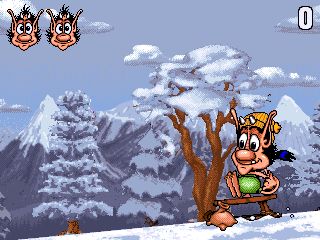
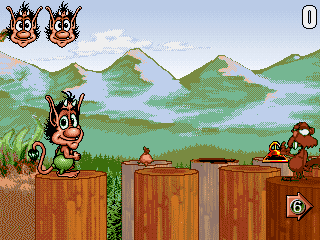
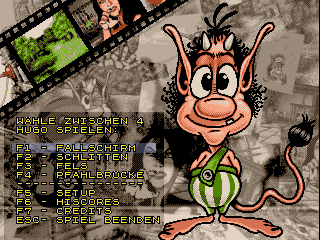
Its stages work because their themes change the feel of the timing test. Skydiving, sledding, climbing, and pole running at least stop the game from feeling like one repeated course, and choosing three before the final challenge adds a small amount of control over a playthrough. The route selection is not deep strategy, but it gives you a reason to favor the rounds that suit your reflexes.
The catch is that Hugo 5’s TV origins are impossible to separate from its design. These levels were built around controlling Hugo through phone-button commands, and the limited inputs remain the whole experience. When your timing is on, that stripped-down approach can be satisfyingly tense. When it is not, there is little room to recover through clever movement or experimentation; you simply need to try again and hit the button correctly.
The bounce-chessboard endgame gives each run a proper destination instead of letting the selected stages trail off. Still, this is a game of brief bursts, not sustained progression. Give it a chance if concise, repeatable timing challenges sound appealing; skip it if you need platform games to offer a broader moveset or a steadily expanding set of ideas.
Graphics
The stage themes give Hugo 5 some welcome visual variety: a skydiving round, a sledding course, a climbing stage, a pole run, and a chessboard-based finale do not blur into one location. That clear separation suits a game built around quick, immediately understood challenges.

Story
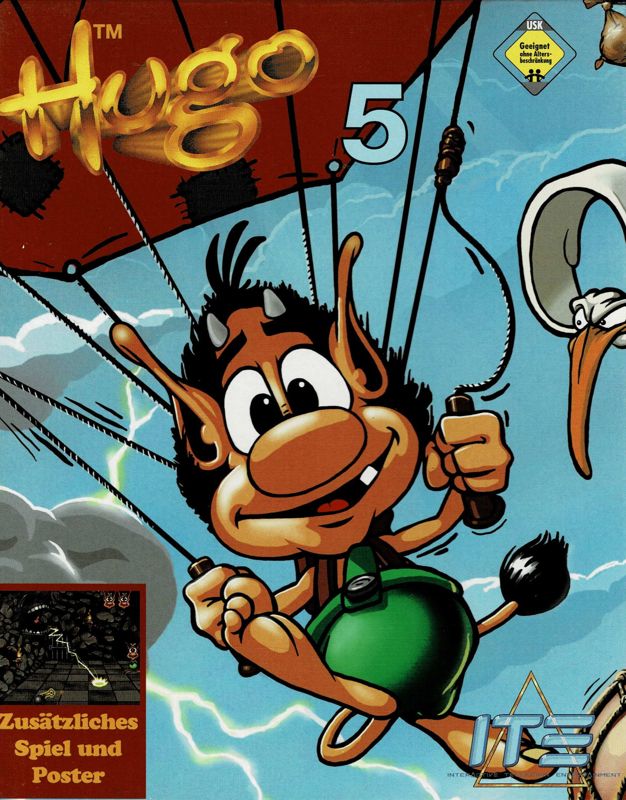
Hexana kidnaps Hugo’s family, and Hugo heads out to rescue them. It is a clean Saturday-morning setup, useful mainly because it puts Hugo in motion and gives the final goal a little more urgency than a disconnected collection of TV challenges would have.
Do not come here expecting the rescue plot to carry the game. The structure puts the focus squarely on getting through your chosen three levels and reaching the endgame, so the story works as a framing device rather than a source of drama or surprise.
That is not necessarily a flaw for this kind of game. The premise is simple enough to understand instantly, and it matches the fast, obstacle-driven format. Hugo’s family gives you a reason to finish, but the real question is whether the individual timing trials hold your attention.
Overall Experience
Hugo 5 feels most at home in a short session: make your selections, test your reactions, and see whether you can put together a clean run. Its strongest quality is its lack of friction. You do not have to decode complicated rules before the action starts, which makes it approachable even for someone who rarely plays older licensed games.
At the same time, that accessibility comes with a narrow ceiling. The simple controls were sensible for an interactive TV format, but in a standalone game they can make success feel dependent on precision alone. If the timing challenges click with you, repetition becomes part of the fun; if they do not, the game has limited ways to win you back.
This is a modest but understandable Hugo adaptation rather than an essential action game. Hugo fans may get the most out of revisiting its familiar TV-show challenge format, while reflex-game enthusiasts can find a few enjoyable minutes in its compact runs. Everyone else will likely appreciate the premise more than the long-term replay value.


Reviews
There are no reviews yet.