 Retro Replay Retro Gaming History, Reviews & Emulation
Retro Replay Review
Gameplay
The first hour’s hook is the war economy. Insectia victories earn bounties, and those bounties go straight back into buying or improving ships. It is a simple loop, but a strong one: combat has a financial consequence, and money has an immediate military use. If you enjoy games where a successful sortie feeds the next strategic decision, Inter-Stellar Wars gives you a reason to care about each win beyond a running kill count.
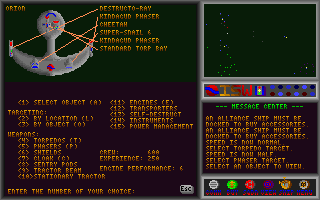
Fleet construction is where the game has its most promising depth. Fighters, command vessels, and cargo ships each come in three classes, while weapons, engine size, shields, tractor beams, and cloaking devices can be selected to suit your plans. That range makes it easy to imagine very different priorities: spend on survivability, push for faster engines, or put resources into equipment that changes how a ship is used. The breadth is inviting, although it also means you need to be comfortable making equipment choices without the instant simplicity of a pure action game.
You can fly ships manually or hand control to the computer, which is a welcome choice for a game straddling combat and management. Manual control lets you stay close to the fighting; computer control makes it easier to think about the wider fleet. Crew experience adds another long-term layer, since veteran crews repair faster and perform better in battle. That progression gives even routine engagements some value, because surviving ships are not interchangeable pieces of hardware.
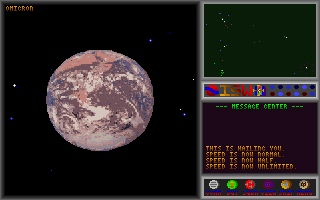
The trading and empire-building frame sounds richer than a straight war campaign. Renzaar, Alpha, and Ordan begin with established peaceful trade, while Creendok remains a dangerous unknown behind the asteroid-ringed world of Regulus. The catch is that the game asks you to enjoy several overlapping concerns—commerce, ship spending, customization, crew growth, and war—rather than delivering one narrowly focused fantasy. Come for a deliberate space strategy game, not for a quick blast of starfighter action.
Graphics
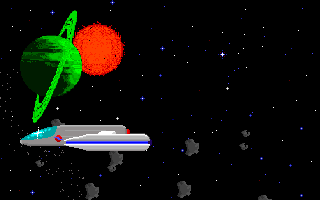
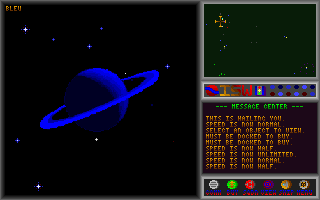
The clearest visual scene is the opening: a ship is destroyed near Regulus before the story jumps ahead fifty years. The colonial backdrop also has a pleasingly old-school science-fiction image to it, with people living underground or beneath huge glass-composite domes on planets that cannot easily support ordinary settlement.
Story
There is a useful sense that the crisis did not begin when you arrived. Humans colonized the Renzaar system in 2249, built peaceful diplomatic and trade ties with Alpha and Ordan, and learned to live around hazardous worlds and asteroid belts. Then the Insectia announce an intention to conquer humanity. That contrast between a functioning trade network and a sudden existential war gives the conflict more weight than a generic “aliens attack” setup.
The fifty-year jump is especially effective as a framing device. By the time the president speaks to your starfighter captain, there have been no victories for a month, the war is expensive, and political unrest is mounting. You enter as someone being judged against a long record of failure, not as a fresh recruit with an uncomplicated mission. It makes every bounty-funded improvement feel tied to a larger, strained war effort.
Do not expect the premise to be a character-driven drama. The supplied conflict is carried by the president’s briefing, the wider state of the alliance, and your own results in the field. Still, it does its job: you have a clear enemy, a galaxy with established relationships worth protecting, and a believable reason that trading and military work are intertwined.
Overall Experience
Inter-Stellar Wars is most interesting when you treat it as a campaign of gradual recovery. A victory earns money; money changes the fleet; experienced crews make ships more dependable; and that improved force can take on the Insectia more effectively. It is an appealing chain of cause and effect, and it gives the game more staying power than a space combat game where success disappears after each mission.
Frustration is likely to set in if you want one dominant mode. The game’s identity is deliberately split between flying, automated combat, trading, and empire-minded fleet management. Its many ship options can feel like work if you only want immediate action, while its combat focus may interrupt anyone looking for a purely economic simulation. The best approach is to embrace the back-and-forth: fight when you want direct involvement, automate when you want to manage, and let the bounty system connect both sides.
Give it a chance if the idea of building a customized space fleet inside a pressured wartime economy sounds more satisfying than chasing a scripted heroic adventure. The underlying premise is sturdy, the progression has a practical payoff, and the option to move between pilot and commander roles is a genuine strength. It is a better fit for patient tinkerers than for gamers who need constant spectacle, but its broad space-strategy ambition is easy to respect.


Reviews
There are no reviews yet.