 Retro Replay Retro Gaming History, Reviews & Emulation

Retro Replay Review
Gameplay
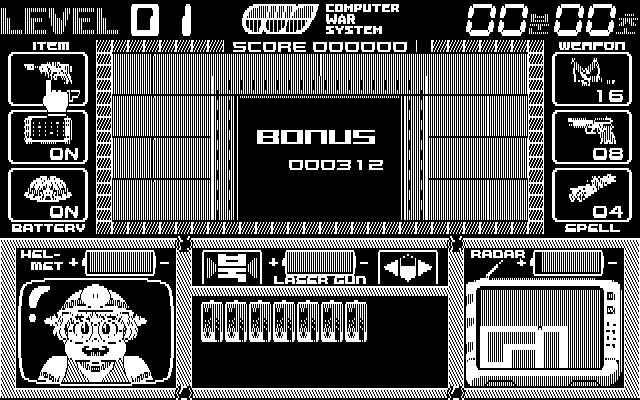
Korean Dungeon Boy starts with a clean survival challenge: get through a labyrinth and reach the exit before the stage timer hits zero. That simple goal gives the first hour a sharp sense of urgency. You are not merely wandering corridors; every wrong turn costs time, and every stop to fight asks whether the delay is worth it.
The aiming system is the game’s most distinctive wrinkle. Movement is free, but you steer a cursor with the arrow keys to aim and fire. It makes combat more involved than simply facing an enemy and shooting, yet it can also be the source of real friction when you need to reposition and line up an attack under pressure. If you enjoy old games that make you actively manage your aim rather than smoothing everything over, there is genuine tension here. If you want effortless first-person gunplay, this will feel like a fight with the controls.
Its firearms bring another layer of decision-making because most consume ammunition, while others depend on batteries. Batteries are especially valuable: they also charge armor and keep the radar’s mini-map working. That turns pickups into meaningful choices rather than routine loot. Spending power to stay protected or keep your bearings can be smart, but it leaves less for battery-fed weaponry.
Spells function as expendable tools, fitting neatly into a game built around finite supplies and a ticking clock. Korean Dungeon Boy is at its strongest when you are reading the maze, watching the timer, and deciding whether to shoot, conserve, or push onward. The payoff is a compact, demanding dungeon run for gamers who enjoy pressure and planning more than comfort.
Graphics
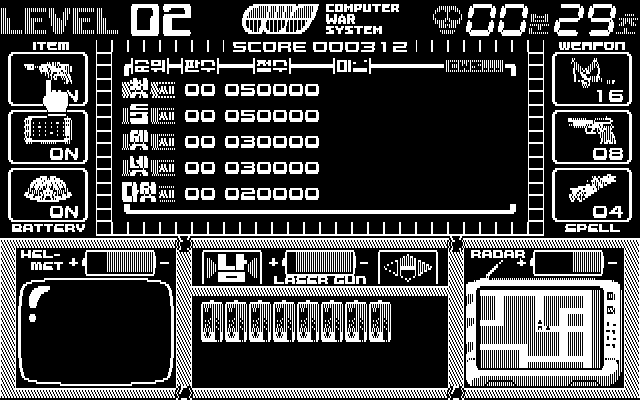
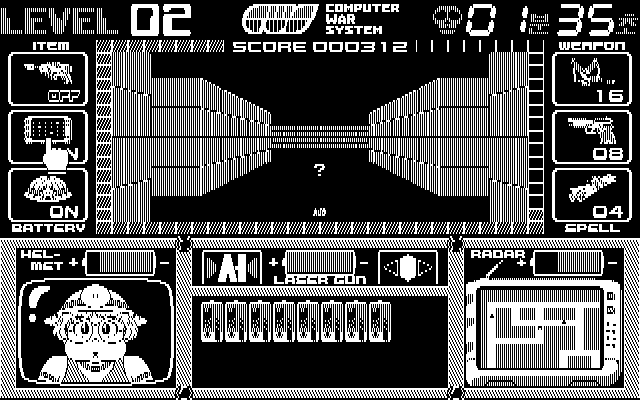
The game uses pseudo-3D monochrome first-person dungeon views. The black-and-white look keeps the focus on corridors, enemies, and the route ahead, while the radar supplies a small map when it has battery power. It is a stark, old-school image, suited to navigation and tension rather than decoration.
Story
The story setup is direct: you play the titular Dungeon Boy, moving through labyrinths in search of each stage’s exit. That puts the emphasis on the immediate problem in front of you rather than on a sprawling adventure tale.
There is a certain charm to how plainly the goal is framed. You are a boy in a dungeon, the way out is somewhere ahead, and time is working against you. The game does not need a complicated premise to make the next corridor matter.
Anyone hoping for character drama or elaborate world-building should not make story the reason to try Korean Dungeon Boy. Its strongest narrative feeling comes from the run itself: the increasing urgency of being lost, low on supplies, and still not at the exit.
Overall Experience
Korean Dungeon Boy is a harsh little hybrid of first-person shooting, maze navigation, and resource management. Its timer prevents the labyrinths from becoming passive mapping exercises, and the battery system gives ordinary pickups unusual weight. When its pieces click, you feel like you are improvising a route through a hostile place rather than simply clearing rooms.
The same traits make it a narrow recommendation. The cursor-based aiming is not likely to win over anyone looking for immediate, fluid shooting, and the pressure of timed stages leaves little room to relax or poke around. Frustration can set in when the controls and the clock demand attention at the same moment.
Still, there is enough personality in that mix to make Korean Dungeon Boy worth a look for fans of early DOS oddities and demanding dungeon crawls. Go in ready to learn its peculiar rhythm, ration batteries carefully, and treat the radar as another resource instead of a permanent safety net. For the right mood, that tension is the whole point.


Reviews
There are no reviews yet.