 Retro Replay Retro Replay gaming reviews, news, emulation, geek stuff and more!
Retro Replay Review
Gameplay
The first pull is straightforward: MadSpace puts you in hostile alien territory and lets you tackle it from a first-person viewpoint with more mobility than a typical corridor shooter. You can walk or fly through the mothership, and the changing laws of physics are the hook that separates it from a routine blast-through-the-level campaign. When a level asks you to rethink where “up” is or how you should move through a space, the game’s strangeness starts to click.
There is a solid amount to chew through in the 25-level campaign, and secret areas encourage you to stop treating each stage as a straight line. The 11 extraterrestrial weapons and 16 enemy types suggest a combat loop with enough moving parts to avoid leaning on one tool for the entire trip. The better mindset is to enjoy the process of probing unfamiliar spaces: this is built around discovering what a room will let you do, not merely clearing it as fast as possible.
MadSpace also reaches beyond a solo campaign in unusually ambitious ways. Up to 16 people can play over a network or modem, turning its odd movement and weaponry into a more unpredictable contest. Speech recognition in gameplay is another distinctly experimental touch. It will intrigue you most if you enjoy games that take big swings at interaction, even when the unusual ideas may demand patience before they feel natural.
Graphics
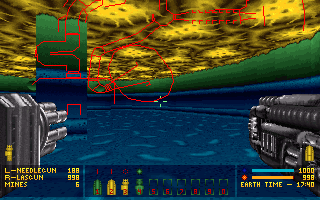
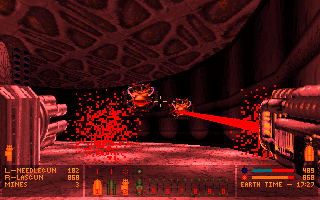
The view stays close to the action in first person, placing alien enemies, extraterrestrial weapons, and the interior of the mothership directly in your path. Some interactive pre-rendered sections and cutscenes can be viewed in Stereo3D, a strikingly specific flourish that fits a game already interested in making its alien spaces feel less conventional.
Story
MadSpace does not waste time on a complicated setup. Humanity is locked in an intergalactic war, you command a ship, and a space battle leads to boarding the hostile alien mothership. That is enough direction to make the invasion feel immediate: you are not sightseeing in a strange place, you are pushing into enemy territory.
The mothership is the story’s useful anchor because it keeps every odd shift in movement and physics connected to one mission. As you advance through its levels, the setting gives the game permission to become increasingly unfamiliar without needing to stop for a long explanation.
Go in for a compact sci-fi conflict rather than a character-driven saga. The narrative mainly gives purpose to the shooting, exploration, and alien technology, and that directness suits a game whose most distinctive storytelling comes from being dropped into a place where normal physical rules can fail you.
Overall Experience
MadSpace is the kind of shooter you remember because it refuses to be entirely ordinary. Flying, walking, warped physics, secret areas, a large weapon roster, multiplayer, and speech recognition are an exuberant collection of ideas for one alien-war game. Not every unusual game earns your patience, but this one has a clear reason to try it: each new area may ask you to play by a different set of assumptions.
You should give it a chance if experimental first-person shooters are more exciting to you than tightly standardized ones. The payoff is in adapting to its peculiar spaces and seeing how far its late-’90s ambition extends, rather than expecting a familiar military sci-fi rhythm from start to finish.
For more release and historical context, the MadSpace history and release information is useful background. As a game, it lands as a fascinating, unevenly approachable curiosity with enough bold design decisions to justify the trip aboard the mothership.


Reviews
There are no reviews yet.