 Retro Replay Retro Gaming History, Reviews & Emulation

Retro Replay Review
Gameplay
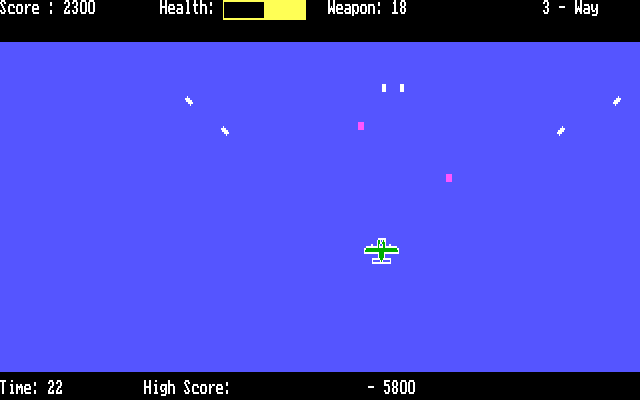
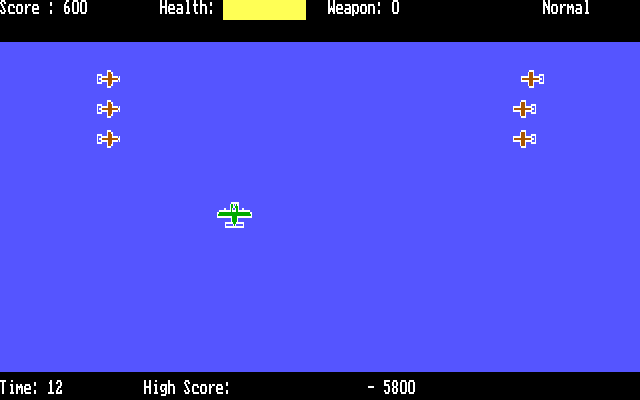
Mustang has the immediate, slightly panicky energy that a good arcade shooter needs. You control a green plane from above, with its nose permanently facing the top of the screen, and enemy aircraft arrive alone or in groups from all sides. At first, that fixed orientation sounds restrictive; once the sky begins filling up, it becomes part of the challenge. You are not dancing around enemies with a plane that can turn on a dime. You are constantly finding safe lanes while keeping your fire pointed upward.
The numeric pad controls are a major part of the deal. They fit the era, but they also ask you to be deliberate with your movement. Enemy planes may sweep straight through or change direction, and they fire bullets and rockets back at you, so casual drifting can turn a manageable wave into a collision course. The game works best when you settle into its compact rhythm: move, line up targets, watch the edges, and resist the urge to chase every threat.
Pickups are the welcome disruption. Health packs can refill your life meter, while missiles and three-way guns temporarily change how you fight. That limited duration gives these items real urgency: grabbing one feels useful, but it does not erase the danger for long. Mustang is not trying to bury you in systems. Its hook is making a small set of threats and temporary advantages matter during a score run.

Graphics
The action is viewed from directly overhead, with your green aircraft easy to spot against the battlefield. Enemy planes approaching singly and in formations make the screen state easy to read, while bullets, rockets, and falling power-up objects give you several moving hazards to track at once.
Story
Mustang frames its action through a simple air-combat scenario: one pilot in a green plane facing incoming enemy aircraft. That is enough for this kind of arcade game, because the tension comes from the immediate question of whether you can survive the next crowded stretch of sky.
Rather than pausing for narrative detours, the game lets each run create its own miniature arc. A steady start can become a scramble when enemies arrive from multiple directions, then swing back in your favor when a health pack or stronger weapon drops into reach.
The high-score list gives the action its cleanest sense of consequence. Getting shot down ends the flight, but a strong run can still earn a place on the board. For a game this focused, that is a fitting finish: the story is the number you managed to leave behind.
Overall Experience
Mustang is at its best when you want a direct arcade challenge with no wasted motion. The first hour is likely to be spent learning how much room you really have around enemy formations and how aggressively to pursue the temporary weapon upgrades. The fixed upward-facing plane and keypad movement will either become an engaging constraint or the point where the game loses you.
Frustration can set in because danger comes from all directions while your shots are aimed upward. That imbalance is purposeful, not accidental: survival depends more on positioning and anticipation than on raw firepower. If you enjoy learning a strict arcade rule set through repeated runs, the pressure feels motivating rather than unfair.
The payoff is modest but real. Mustang will not transform as you play; it keeps returning you to the same essential test and asks for a cleaner, longer run. Give it a chance if you like early-1990s DOS score chasers, tight top-down shooting, and the satisfaction of turning a brief power-up window into a better high-score attempt.


Reviews
There are no reviews yet.