 Retro Replay Retro Gaming History, Reviews & Emulation
Retro Replay Review
Gameplay
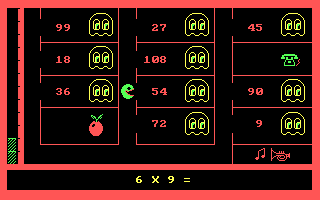
The first few minutes of Number Fun 1 make its intent wonderfully plain: see a simple sum, find or enter the answer, then do it again before attention wanders. For a young child, that directness is a strength. “Munch” turns answer selection into a small chase, asking you to guide a Pac-Man-like character to the correct number and eat it. It is an easy hook for addition and subtraction practice because the answer is something you actively pursue rather than merely recite.
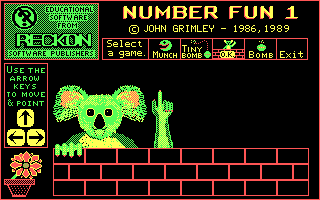
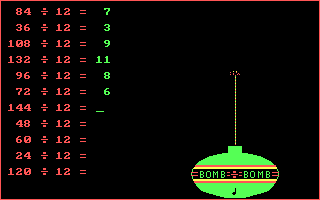
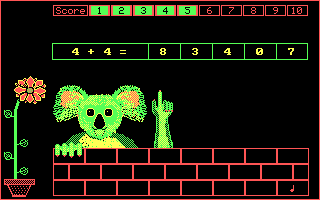
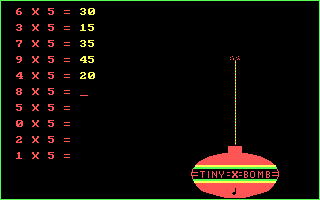
The four activities are close relatives, but they do not all create the same kind of pressure. “Ozzie Koala” again has you navigate to the correct answer and point at it, making it a calmer alternative to the racing clock. “Tiny Bomb” asks you to type answers to addition, subtraction, or multiplication questions before the fuse burns down. “Bomb” follows that model while bringing division into the mix. Kids who enjoy a ticking deadline may find the bomb games exciting; kids still working out facts in their heads may get more value from Munch and Ozzie first.
Difficulty selection is the practical feature that keeps this from being a one-afternoon curiosity. You can start at a level that reinforces number confidence, then raise the challenge rather than abandon the game as soon as the earliest problems become automatic. Still, this is drill-based learning with an arcade wrapper, not a deep puzzle game. The payoff is repetition made more active, and it works best in short sessions where the pressure stays motivating instead of souring into frustration.
Graphics
The game’s most concrete visual hooks are its simple mascots and hazards: a Pac-Man-like figure in Munch, Ozzie Koala in his own activity, and bombs with burning fuses in the timed games. Those images give each arithmetic exercise a distinct face, which matters when the underlying task is repeatedly choosing or typing numbers.
Story
Number Fun 1 frames its action through tiny situations rather than a developing tale. You are chasing answers to munch them, directing a koala toward the right result, or beating a fuse by solving a problem. That is enough context for its age group: every answer has an immediate purpose.
The loose themes also separate the activities without asking a child to follow a plot between them. Moving from the koala game to a bomb challenge feels like changing the flavor of a lesson, not stepping into a new chapter. For a package built around early number skills, that keeps the focus where it belongs.
There is no need to wait for narrative payoff here. The little scenarios exist to make arithmetic feel less like a page of exercises, and the bomb fuse supplies the clearest sense of stakes. If your child responds to playful prompts more than plain questions, that light framing can make practice easier to return to.
Overall Experience
This is a modest but sensible educational game: four ways to rehearse basic operations, with enough contrast between steering, pointing, and typing to break up the routine. The best fit is a preschool or kindergarten-age learner who benefits from seeing number work as a quick game rather than a formal assignment.
Its age shows in the simplicity of the activities, but simplicity is not a flaw when the audience is learning foundational math. The timed bomb rounds are the main dividing line. They can sharpen recall once addition, subtraction, multiplication, or division is starting to click, yet they are less inviting when a child needs time to reason through each answer.
Give it a chance if you want focused arithmetic practice with a little arcade energy and adjustable difficulty. Do not expect it to replace hands-on teaching or offer much beyond its drills. As a short, repeatable companion for building comfort with numbers, though, it has a clear purpose and follows through on it.


Reviews
There are no reviews yet.