 Retro Replay Retro Gaming History, Reviews & Emulation

Retro Replay Review
Gameplay
Rocket Rangers starts with a wonderfully immediate problem: your ship is moving, your opponent is moving, and stopping to think usually means drifting into a shot. Rotate-and-thrust controls make the first few fights feel clumsy in the right way. You are not simply pointing a craft at a target; you are managing inertia, lining up an angle, and deciding whether the energy spent on thrust will leave enough for a weapon or emergency escape.
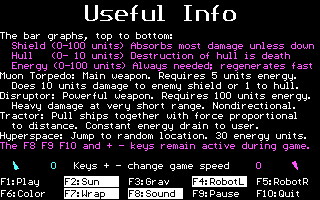
The shield and regenerating energy reserve make the duels more interesting than a single-hit shootout. Firing, thrusting, and special abilities all draw from the same pool, so aggression has a cost. The disruptor sounds like the obvious answer when an enemy gets close, but its short range asks you to commit. The tractor beam can drag both ships into danger, and hyperspace can save you or dump you somewhere worse because its destination is random. That unpredictability gives the game a sharp, scrappy edge.
Arenas become much more demanding once you enable the central gravity well or sun. Flying near the middle is no longer a neutral shortcut, and the sun turns a bad trajectory into an instant lesson. Edge wrap-around is another worthwhile switch: with it on, escape routes become ambush routes; with it off, the borders create a more contained duel. Heavy damage disrupting or disabling controls is especially nasty, since one mistake can leave you trying to steer a wounded ship through an already tense fight.
There is real replay value in adjusting those rules and facing either another person or the computer, but Rocket Rangers lives or dies on your taste for direct head-to-head competition. You will not get a broad progression loop here. What you get is a tight set of systems that reward learning how much momentum, energy, and risk you can afford in a given second.
Graphics
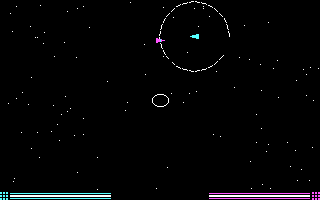
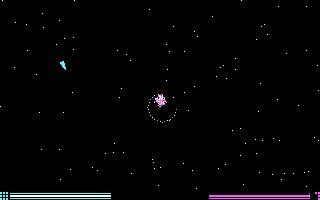
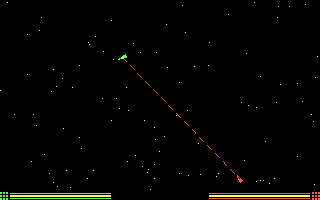
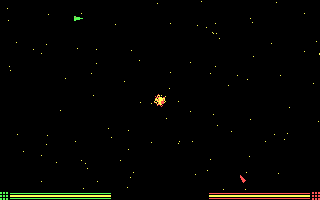
The action is seen from above in a compact arena, with two triangular spacecraft that fit the game’s stripped-down duel format. Their simple shapes make it easy to tell where each ship is facing, which matters constantly when turning and thrusting determine whether you escape, collide, or land a shot.
Story
Rocket Rangers has no need for elaborate narrative setup. Its story is the immediate kill-or-be-killed contest between two spacecraft, and that simplicity suits a game built around repeatable matches.
The tension comes from the little dramas a duel creates: a shield holding just long enough, an energy reserve running low, or a damaged ship losing reliable control at the worst possible moment. None of that asks you to follow characters or plot twists; it gives each round a beginning, a scramble for advantage, and a decisive finish.
If you want a space game with a campaign or a detailed fictional world, this premise will feel thin. If you are happy to supply the rivalry yourself—especially against another human—the minimal setup stays out of the way and lets the match carry the emotion.
Overall Experience
Rocket Rangers is a focused old-school space duel rather than a sprawling shooter. Its best quality is that nearly every option changes the texture of the same basic confrontation: gravity changes flight paths, the sun punishes careless routes, edge wrap changes pursuit, and special abilities turn energy management into mind games.
Expect some early frustration. Inertial controls are unforgiving, hyperspace is a gamble, and control disruption means losing ground can cascade into losing the round. But that harshness is part of the payoff. Once you stop fighting the ship’s momentum and start planning around it, a close duel can become remarkably tense.
Give it a chance if you enjoy Spacewar!-style combat, local competitive games, and systems that ask you to earn precision rather than handing it over. It is not a game for someone looking for variety in missions or story, but as a compact battle of positioning, resources, and nerve, Rocket Rangers has enough tactical bite to keep a good rivalry going.



Reviews
There are no reviews yet.