 Retro Replay Retro Gaming History, Reviews & Emulation
Retro Replay Review
Gameplay
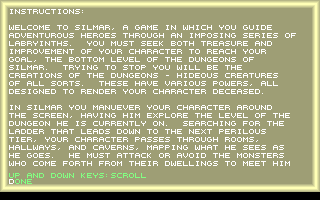
The first few minutes of Silmar get their hook from a familiar but durable promise: there is a cursed dungeon underneath a tower, it is full of monsters and treasure, and you are going down farther than the adventurers who failed before you. Randomly generated dungeons give that descent uncertainty, so a run is less about following a fixed route and more about judging whether your current supplies and loot justify another push.
The village loop gives the crawling some welcome structure. You can buy necessities above ground, sell treasure you recover, and use a teleport bead to get back to safety when the dungeon gets too hot. That bead is more than a convenience; it is the game’s pressure-release valve. Greed has a price, but you are not forced to treat every dangerous moment as an all-or-nothing commitment.
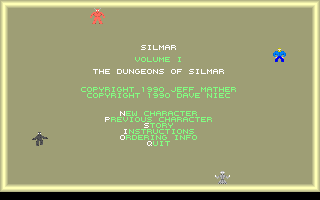
Silmar also embraces oddball character selection in the original version, where a werewolf can sit beside a baseball player on the list of possible adventurers. That silliness will either make the game feel charmingly unrestrained or puncture the fantasy mood completely. The later 2.x version narrows the choice to a human adventurer and expands the above-ground services with a smithy, priest, wizard, shop, trader, and messenger, making its town routine feel more defined. In either form, this is a lean dungeon-crawling game built around repeated expeditions, not a gentle introduction to role-playing.
Graphics
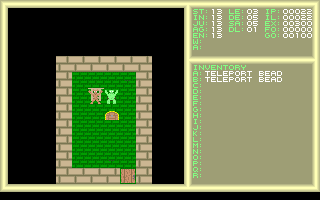
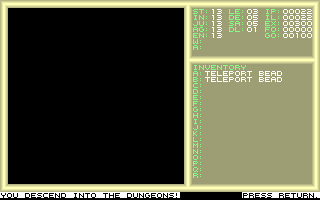
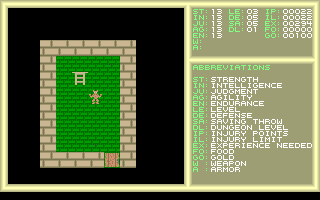
The DOS release uses tile-based graphics, matching its top-down dungeon-crawl format. Later 2.x versions switch to pixel-based graphics and use a different map screen and player-character approach. Neither version is chasing grandeur; the important visual distinction is that they are not interchangeable editions, especially if you care about the original’s wider character selection.
Story
Silmar begins with a clean fantasy setup. The evil wizard Syrilboltus was beaten in a war against the dwarven country of Gormarundon, but his legacy is a cursed labyrinth beneath his tower near the village of Silmarii. The threat is not abstract: the dungeons are crawling with monsters, and somebody has to reach the bottom, cleanse them, and seal them.
That is a functional reason to keep descending, and it suits a roguelike better than a heavily scripted quest would. You are not being asked to untangle a large cast or track elaborate political intrigue. You are the next adventurer taking a chance where many others have failed, which gives each retreat and return to town a little more weight.
The tone is less consistently solemn than the backstory suggests. Letting the original game’s adventurer list include such mismatched choices as baseball players makes Silmar feel knowingly strange as often as it feels grim. If you want a pure dwarf-and-wizard fantasy, that joke may grate. If you enjoy old RPGs with a streak of nonsense in their veins, it is part of the appeal.
Overall Experience
Silmar is easy to respect when you are in the mood for a direct, no-frills descent into danger. The rhythm of exploring a random dungeon, fighting for loot, escaping back to town, and buying your way into another attempt has lasted for good reason. The teleport bead and village economy give you room to make decisions instead of merely absorbing punishment.
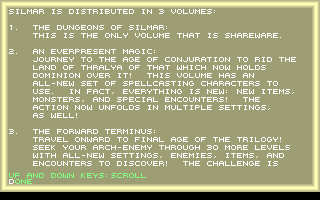
Its age shows in how little it tries to smooth over its roughness. The humor is uneven, the fantasy premise is deliberately basic, and the game’s identity changes noticeably between the DOS original and the later 2.x release. The original was split across three parts, with Dungeons of Silmar as the shareware entry and An Everpresent Magic and The Forward Terminus following it, so the complete journey has a distinctly old PC-distribution feel.
Give Silmar a chance if you enjoy early roguelike habits: cautious descents, resource purchases, treasure runs, and the constant temptation to stay underground one floor too long. Its payoff is not a polished modern campaign; it is the satisfaction of surviving an unpredictable dungeon on your own terms. That is enough to make this a worthwhile historical crawl for patient dungeon fans, even if its eccentricities mean it will not be everybody’s idea of fantasy comfort food.


Reviews
There are no reviews yet.