 Retro Replay Retro Gaming History, Reviews & Emulation
Retro Replay Review
Gameplay
The Pit of Jagadha gets to the point quickly. Instead of the long setup associated with a full role-playing game, you enter with Magni Ersthaven, a pre-made 16th-level Breton Spellsword, and immediately have a high-level spellbook worth experimenting with. That makes the first hour more playful than methodical: you are not building toward power, you are already holding it and figuring out how to spend it.
The dungeon layout stays the same, but some monster types and placements change whenever you restart. That is a modest form of replay value, yet it matters because this is a no-save experience. A failed run does not become a disaster when the whole point is trying a different approach, perhaps with a different roll of attributes and starting equipment. The fixed map also means familiarity gradually replaces confusion, while the changing threats stop every return from feeling completely scripted.
The restrictions are hard to ignore. Magni cannot level up, and the character-generator, spell-maker, item-maker, and potion-maker previews are demonstrations rather than tools that feed into the adventure. You can look at those systems, but you cannot turn that curiosity into a tailored dungeon run. If you want character ownership and long-term progression, this will feel like an appetizer that ends just as you want the meal.
Still, there is value in that narrowness. The demo gives you a concentrated chance to handle a powerful character and swap equipment without asking for a major commitment. It is much more satisfying as a repeatable dungeon challenge and a peek at an earlier build than as a self-contained RPG campaign.
Graphics
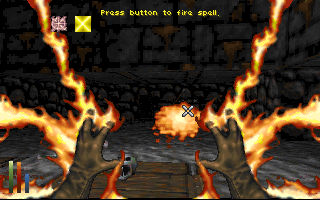
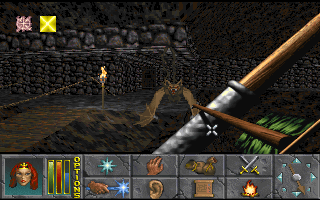
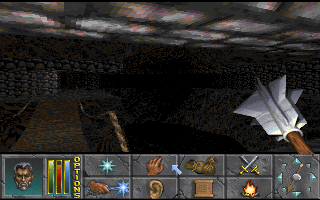
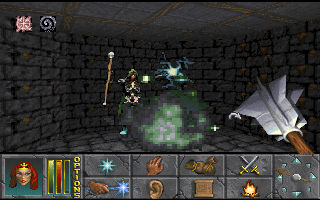
You explore the dungeon from a first-person view, in an early version whose interface and graphics differ noticeably from the final game. The enclosed dungeon setting keeps the focus on navigating its spaces and confronting whatever monsters the latest restart has placed in your path.
Story
Story is barely the point here. The demo supplies a named hero, Magni Ersthaven, and a destination, the Pit of Jagadha, but its real concern is putting that character into a dungeon rather than building a narrative around him. Do not expect the kind of quest momentum that carries a full Elder Scrolls game.
That spare framing is not necessarily a flaw for a demo from this era. It makes every run feel immediate: you are in the pit, you have a capable spellsword, and the question is whether you can work through its dangers. But anyone arriving for lore, choices, or a memorable plot will reach the edge of this slice very quickly.
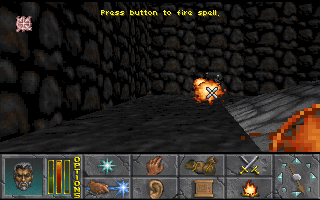
The more interesting context is historical. This is an unusually early Daggerfall build, so its altered interface, graphics, and mechanics make it feel like a snapshot of a game still taking shape. That gives the demo extra interest if you enjoy comparing versions, even when its story offers little reason to linger.
Overall Experience
The Daggerfall demo is easy to recommend with the right expectation: it is a compact, rough-edged dungeon excursion where a high-level spellbook does much of the heavy lifting. The inability to save can be irritating, especially once a run starts going well, but it also keeps the stakes small enough that restarting feels natural rather than punishing.
Give it a try if you are curious about DOS-era Elder Scrolls, enjoy poking at old RPG systems, or want a quick first-person fantasy dungeon run with a little encounter variation. The preview tools are fun to inspect, though their separation from actual play is a tease. You will get more mileage from the full game, but this is a worthwhile historical detour.
Its payoff is not completion or progression; it is the chance to feel an early Daggerfall experiment in motion. For an evening of spell-slinging and dungeon delving, that is enough. For anything deeper, it mainly leaves you wanting to move on to the finished adventure.
Reviews
There are no reviews yet.