 Retro Replay Retro Gaming History, Reviews & Emulation


Retro Replay Review
Gameplay
Tommy’s Starball is at its best when you stop treating movement as a way to get somewhere and start treating it as a way to survive your own firing pattern. Your star shoots automatically up, down, left, and right, so destruction is always happening around you. At first, that feels generous: points arrive without any need to aim. Then a shot loops off an edge, returns from the other side of the field, and makes it painfully clear that every direction is dangerous.
The movement rule is the clever part. Move toward another star and you become that star; move toward an empty space and you advance by one position. In practice, you are constantly judging whether a nearby star is a useful jump target, a source of immediate points, or a risky place to occupy while antiparticles are circling back. Stars also reform, preventing the board from staying safely cleared and keeping the pressure on.
That combination gives this a stronger tactical edge than its automatic shooting initially suggests. You do not control the shots, but you control where their cross-shaped lines of fire originate. Good play means jumping into crowded areas to create targets, then moving again before the returning fire catches up with you. Frustration can set in when a previously fired particle completes its long trip at exactly the wrong moment, but that danger is the whole point rather than a random interruption.
Nine difficulty levels and separate high-score tables make the game easy to revisit with a concrete goal. This is not a sprawling strategy game; it is a concentrated board of positioning decisions and escalating self-preservation. Give it a chance if you enjoy learning a small rule set until every move carries several consequences.
Graphics
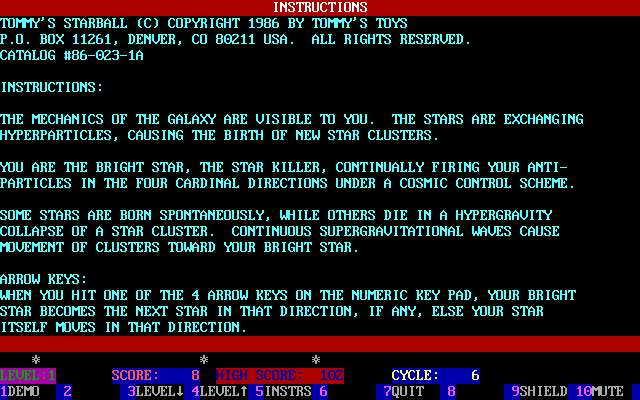
The action takes place in a fixed, top-down star field, with stars acting as both targets and places you can jump to. The uncluttered single-screen layout suits the game well: with shots travelling in four directions and wrapping across the edges, you need to keep the entire field in your head at once.

Story
You play the role of a death star in a hostile field of other stars, destroying them with antiparticles for points. It is a bare sci-fi setup, but it gives the score chase a suitably cold, impersonal tone: you are less a hero on a mission than a lethal object trying not to be caught by its own output.
The strongest bit of implied drama comes from curved space. Fire does not simply disappear when it leaves the battlefield; it comes back. That turns the central fiction into a useful source of tension, because every attack remains part of the danger around you.
The game’s real narrative is the one created by a run: an early burst of safe-looking destruction, a crowded jump toward more targets, and the eventual realization that old shots are still hunting across the screen. For a high-score arcade game, that is enough context to make failure feel like a consequence of your decisions.
Overall Experience
Tommy’s Starball has the sort of clean, cruel logic that can hook you quickly. Automatic four-way fire sounds passive on paper, yet the wraparound shots and jump movement make every position a commitment. Once the rules click, you are no longer waiting for points; you are arranging the field so that destruction works for you without immediately coming back to kill you.
Its limits are also obvious: the entire experience rests on one compact arena and one central scoring loop. If you need varied objectives or a long campaign to stay engaged, this will feel slight. If you like old-school games that ask you to master a single nasty idea, the repeated runs have real bite.
The nine difficulty settings are especially welcome because they let the basic game grow with your confidence. Start low enough to understand how returning antiparticles behave, then move upward once you can read crowded fields without panicking. The payoff is not grandeur; it is the satisfaction of turning a seemingly simple four-direction shooter into a controlled, high-risk puzzle.


Reviews
There are no reviews yet.