 Retro Replay Retro Gaming History, Reviews & Emulation


Retro Replay Review
Gameplay
The first jump is where Visual Star Trek earns its name and its lineage. You click into a sector knowing the map will show planets and starbases but not the Klingons waiting there, so exploration carries real nerves. A safe jump buys you time to plan; a bad one immediately turns into a resource-management problem. That uncertainty is a better fit for this kind of galaxy patrol than simply revealing every target from the outset.
Combat is built around choices that are easy to understand and hard to make carelessly. Shields, phaser cannons, photon torpedoes, and energy all demand attention, and the experimental death ray adds a deliberately extreme option: it can destroy a planet. The game is not merely asking whether you can win a fight, but whether you can win it quickly enough to preserve the tools needed for the next surprise encounter. If you come out battered, nearby starbases offer a crucial chance to replenish energy and weapons, making their positions strategically important rather than decorative.
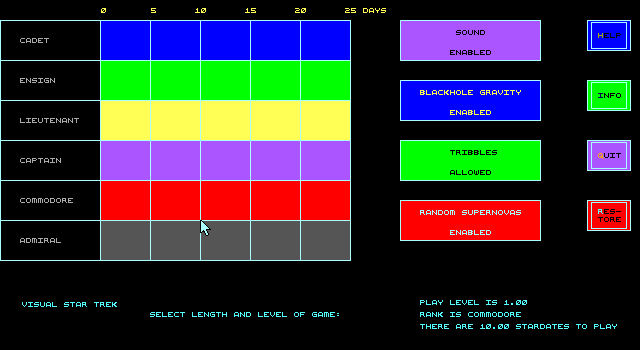
The six military ranks are a smart way to meet the game at your preferred level, especially since you also choose the number of turns. Black-hole gravity, random supernovas, and tribbles can be switched off, which is welcome: veterans can embrace a hostile, unpredictable map, while newcomers can learn the core hunt without every trip becoming a cosmic disaster. Romulans and Tholians further prevent the war from feeling like a one-enemy routine.
Its biggest strength is that it turns a compact set of systems into persistent pressure. You have goals, limited time, incomplete information, and hazards that can alter a good plan. Frustration can certainly set in when a jump exposes you to trouble at the wrong moment, but that is also where the game’s decisions gain their bite. Give it a chance if you enjoy deliberate, turn-based space command more than fast action.
Graphics
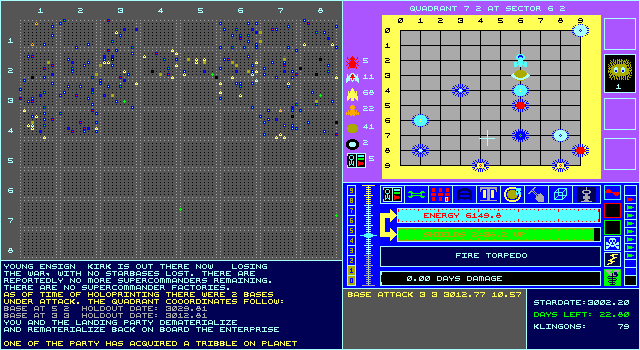
The main screen is organized for command rather than ornament: a detailed status overview sits at top left, the quadrant map at top right, a right-side HUD holds options, and event messages run along the bottom left. That arrangement keeps the information you need close at hand while you decide where to jump and how to respond.

Story
The story is a clean wartime assignment: the United Federation of Planets and the Klingon Empire are at war, and you are sent to remove Klingon forces from the known galaxy. It is a direct setup, but it suits a game concerned with maps, turns, and tactical survival.
Rather than leaning on a long narrative, Visual Star Trek lets the campaign’s drama come from the state of the galaxy. A dwindling turn count, an underpowered ship, a helpful starbase, or an unexpected hostile encounter can make your own route through the war feel urgent. The Romulans, Tholians, supernovas, black holes, and tribbles make space feel less like a neat battlefield and more like a place that refuses to cooperate with military plans.
That sparse approach will not satisfy you if you want character scenes or a plot full of twists. It does, however, give the game a brisk Star Trek-style mission frame: go out, assess danger, conserve what matters, and try to return from an increasingly messy patrol with the job done.
Overall Experience
Visual Star Trek is a satisfying refinement of the classic Trek-style strategy formula because it keeps the tension of blind jumps and limited resources while making interaction more approachable with a mouse-based interface. The real pleasure is not any single weapon or hazard; it is the moment you realize that every jump has consequences and that a victory can still leave you poorly prepared for what lies one sector away.
The game does ask for patience. Its rhythm is methodical, and bad luck can sting when hidden enemies or optional space hazards collide with a tight turn budget. Yet the ability to tune difficulty by rank, turn count, and hazard settings makes that sternness more adjustable than it first appears. Start with the extra hazards disabled if you want to learn the fundamentals, then turn them on when straightforward Klingon hunting begins to feel too comfortable.
For fans of Super Star Trek and EGA Trek, this is an easy recommendation; it understands why those games work. Anyone who likes turn-based strategy with incomplete information, careful resupply, and the constant possibility that one jump will wreck an otherwise sound plan should also make room for it. The payoff is a focused command game that repeatedly makes you weigh boldness against survival.



Reviews
There are no reviews yet.