 Retro Replay Retro Gaming History, Reviews & Emulation
Retro Replay Review
Gameplay
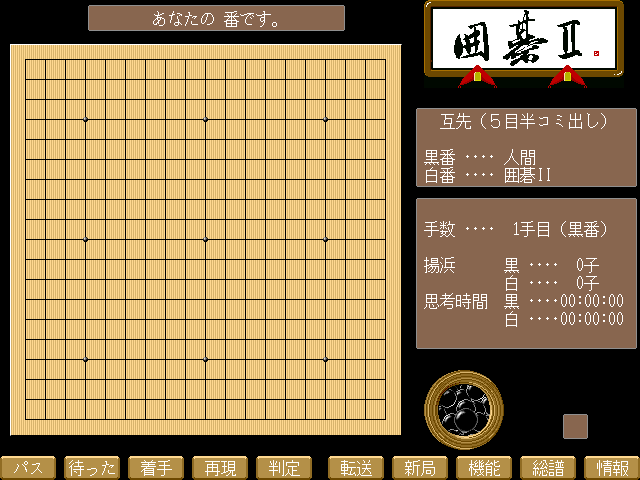
Igo II understands that go does not need dressing up to be absorbing. You place a stone, answer a threat, then realize that the move you made across the board has changed the value of the position in front of you. The first hour can be humbling if you are new to weiqi, because the board offers so much freedom that every choice can feel suspicious. Stick with it. Once you begin recognizing that influence, space, and safety are connected, each turn gains a satisfying weight.
The range from beginner to advanced difficulty is the right foundation for a game like this. A novice can start at a level that leaves room to think, while experienced go players have tougher computer opposition to test their reading. It is a patient kind of strategy rather than a flashy one: expect long pauses, second guesses, and the occasional sinking realization that a seemingly small local decision has cost you elsewhere.
Undo is more than a convenience here; it is one of the game’s best teaching tools. You can retrace a bad idea before committing to an entire lost position, which encourages experimentation instead of fear. Letting the AI take over for demonstrations and suggestions also gives Igo II a useful tutoring streak. It will not replace the satisfaction of working out a position yourself, but it can help you see why a move that looked sensible was not.
Graphics
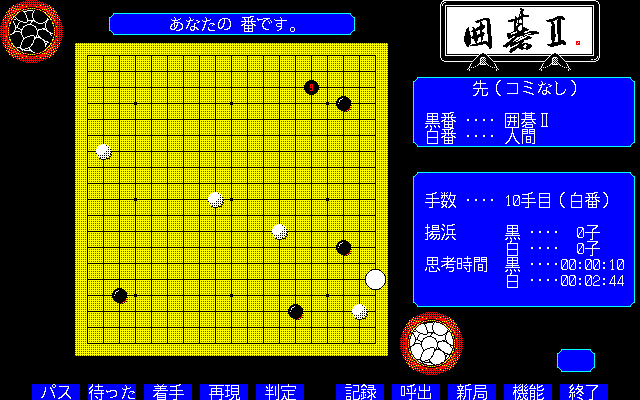
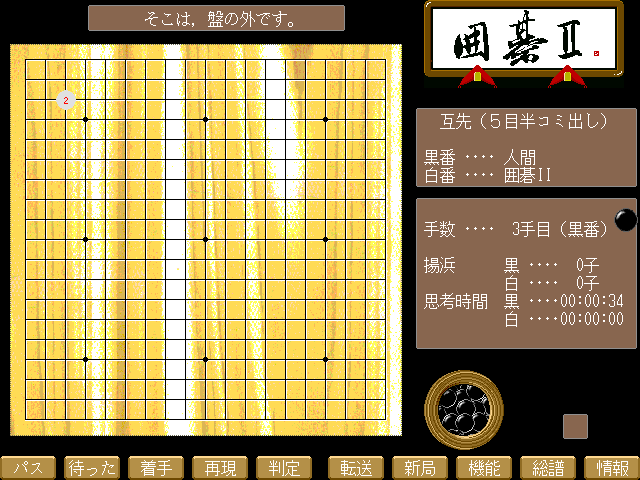
The FM Towns version lets you play on wood, stone, sky-themed, and space-themed boards. That is a welcome bit of variety for a game spent staring at the same grid for long stretches, and the different surfaces give you a simple way to choose between a traditional board and something more playful.

Story
There is no authored adventure pulling you from match to match. Igo II’s story is the one you make across the board: a promising opening, a tense fight for a corner, and a late-game count that makes you revisit every earlier decision.
That kind of drama is wonderfully personal. A strong move feels clever because you discovered its value, while a blunder stings because you can usually trace the disaster back to your own impatience.
The computer opponent gives those games a useful sense of progression. Moving from beginner opposition toward advanced play creates its own arc, not through cutscenes or characters, but through the gradual proof that you are seeing more of the board than you did before.
Overall Experience
Igo II is a disciplined adaptation for gamers who want to spend time thinking rather than being entertained between turns. Its strongest quality is that it gives go room to breathe while including practical help for learning: adjustable challenge, take-backs, demonstrations, and suggestions. That combination makes it approachable without making the game shallow.
Frustration is part of the bargain. Go can make you feel lost, especially when the board is open and it is unclear where the urgent fight really is. The advice features soften that wall, but they do not remove the need to study positions and accept mistakes. If you need constant action or quick rewards, this will feel austere.
For anyone curious about weiqi, though, Igo II earns a recommendation. The themed board choices are a pleasant extra, but the real payoff is watching your own understanding improve from game to game. It is an old-school board-game program with the good sense to trust one of history’s deepest strategy games.


Reviews
There are no reviews yet.