 Retro Replay Retro Gaming History, Reviews & Emulation
Retro Replay Review
Gameplay
Samurai Kid starts like a brisk side-scrolling adventure, with Prince Homuramaru crossing platforms, meeting enemies, and pushing into the Demon King’s territory. It does not stay a simple run-and-slash game for long. Its most interesting idea is that enemies are often part of the solution: you may need to move or lure one into the right spot to open the way ahead rather than merely clear it from the screen.
Three weapons give that puzzle design some useful range. Their destructive, luring, and petrifying effects can handle enemies, mechanisms, and traps, so the key is learning which property fits the obstacle in front of you. When the answer clicks, it feels good because you have changed how you look at the room, not just found a hidden switch. Boss battles also give each stretch of the ten monster castles a proper punctuation mark.
The tradeoff is momentum. You will hit moments where the route is not obvious and need to test possibilities, which can feel stubborn when you only want to continue platforming. That friction is part of the game’s character, though. If you enjoy the environmental problem-solving of Wario Land 3, Samurai Kid is worth a look, even though its weapons and progression take a different path.
Graphics
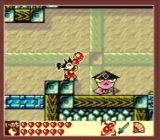
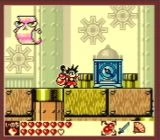
The game’s small black-haired hero, marked by a red hair tuft and pale clothes, is easy to pick out in the mechanical interiors. Pink floating creatures in pointed hats pop nicely against beige-green rooms built from patterned square walls, chunky yellow-brown blocks, blue machinery, and thin raised platforms. The dense geometric backgrounds can crowd the tiny figures, however, so busy encounters demand a closer look.
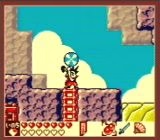
Outdoor areas offer a welcome change, with Homuramaru climbing red ladders through mottled purple-brown stone beneath a turquoise sky and large pale-yellow clouds. It is a simple but colorful Game Boy Color scene that makes the castle interiors feel less monotonous.
Story
You play as Prince Homuramaru, whose homeland is under threat from the Demon King’s army. It is a clean, direct reason to set out, and Samurai Kid wisely keeps the focus on the journey through dangerous castles rather than asking you to carry a complicated plot in your head between puzzles.
Two animal companions join Homuramaru on the quest, adding a bit of warmth to an otherwise straightforward demon-army premise. The story’s real value is its forward drive: each new castle feels like another step toward confronting the threat hanging over his home.
Do not come here expecting the narrative to eclipse the action-puzzle design. The stakes are classic heroic fantasy, and that is enough. For background on the original game’s castles and puzzle weapons, the original Koei game page is a useful companion.
Overall Experience
Samurai Kid earns its place by making you reconsider familiar platform-game habits. Enemies are not always targets, weapons are not only for damage, and a room that first looks like a nuisance can turn into a satisfying little logic problem. That gives the adventure a more deliberate flavor than its cute hero and compact Game Boy Color format initially suggest.
Its frustrations are easy to understand. Small sprites and packed scenery can make a puzzle room feel cluttered, while trial and error can interrupt the flow. Yet the game has a coherent point of view, and it rewards patience more often than it punishes it.
Give it a chance if you want an obscure Game Boy Color platformer with more to chew on than reflex tests. Samurai Kid is not for someone seeking nonstop swordplay, but its blend of traversal, enemy manipulation, traps, and boss encounters makes the payoff worthwhile when you are in the mood to pause, experiment, and find the clever route forward.


Reviews
There are no reviews yet.