 Retro Replay Retro Gaming History, Reviews & Emulation
Retro Replay Review
Gameplay
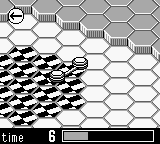
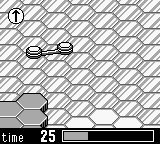
LUCLE starts by making you feel a little foolish, then slowly lets you feel clever. You are not flying freely around each stage. Instead, one circular cockpit stays planted while the other rotates around it on a rigid rod; switching which cockpit is fixed is how you inch the whole ship across the map. In the first hour, much of the fun comes from wrestling with that strange idea. Every move asks you to picture where the far cockpit will swing, not merely where you want to go.
That makes even a simple trip to an energy field a proper spatial puzzle. Tight passages are dangerous because the rod and the rotating cockpit need room, and touching obstacles is exactly the kind of mistake you make when you rush a turn. Once the controls start to click, LUCLE has a satisfying stop-and-think rhythm: set an anchor, rotate into a safer angle, switch over, then repeat. It is deliberate rather than fluid, but that awkwardness is the point.
The time limit keeps the puzzle-solving from becoming too comfortable. You cannot spend forever testing every possible route, so a level eventually becomes about balancing caution against momentum. Power-ups such as the compass add useful help, while unlimited lives make experimentation far less punishing than the timer initially suggests. You will still restart stages after a bad collision or a slow route, but the game wants persistence, not perfection on the first try.
Frustration can set in when you understand the destination but cannot quite maneuver the ship’s shape through the route cleanly. LUCLE asks for patience and a willingness to adapt to its movement rules; it is not the kind of action game where quick reflexes alone rescue a sloppy plan. If you enjoy compact puzzles built around mastering one odd, memorable constraint, that commitment pays off.
Graphics
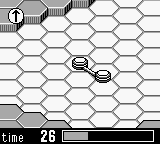
The isometric Game Boy stages give the ship and its connecting rod enough visual space that you can judge each rotation and line up careful movement around obstacles. The two-cockpit design is especially important because it keeps the game’s unusual movement readable at a glance.
Story
The story is a clean sci-fi setup: your spacecraft is stranded on an alien planet, and each level’s energy field is another step toward getting away. It gives the puzzles a clear purpose without getting in the way of them.
That restraint fits LUCLE. The game is interested in the practical problem of escaping one hazardous area at a time, not in turning the premise into a large narrative journey. You are here to solve routes, manage the clock, and gradually become competent with a machine that initially feels almost impossible to steer.
Because the goal remains so direct, each completed level has a pleasing sense of progress. Finding the energy field is not a story twist; it is a small, earned release after you have worked out how to thread the ship through another obstacle course.
Overall Experience
LUCLE earns its 7/10 by committing fully to a single eccentric idea and finding plenty of tension inside it. The two-anchor movement is more than a novelty: it changes how you read space, how you approach hazards, and how you react to a ticking timer. Few games make moving from one side of a room to the other feel this much like a puzzle.
It is not effortless fun. The deliberate controls and rigid ship shape can feel stubborn before your brain adjusts, and the clock can turn a near-solution into an irritating restart. Still, unlimited lives are a crucial kindness, letting you learn through repeated attempts instead of fearing a depleted continue count.
Give it a chance if you like Game Boy puzzle-action games that demand spatial planning more than button mashing. LUCLE is a small, focused challenge with an unusual hook, and its payoff arrives when you stop fighting the ship’s limitations and start using them to plot a route.


Reviews
There are no reviews yet.