 Retro Replay Retro Gaming History, Reviews & Emulation


Retro Replay Review
Gameplay
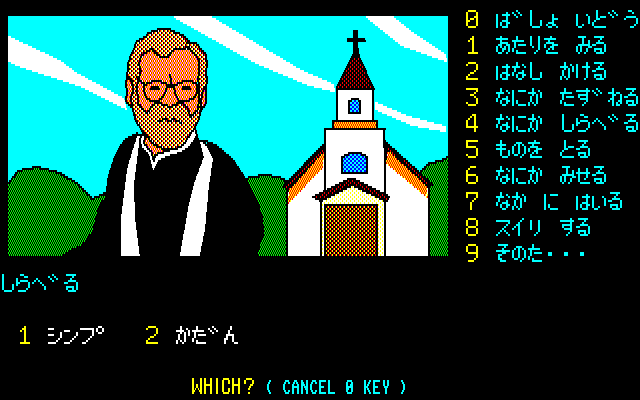
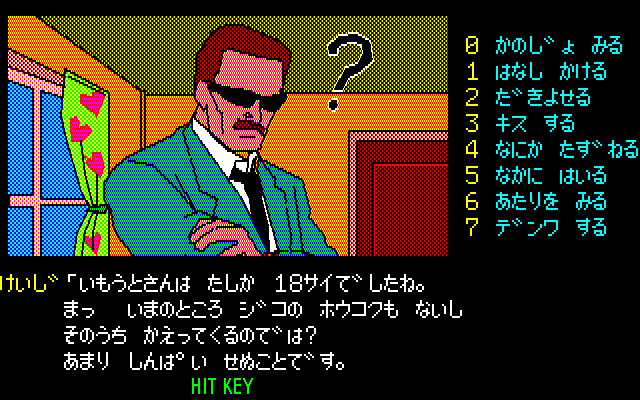
The first hour’s pull comes from the disappearance itself. Nagisa vanishes during what should have been an ordinary outing, a strange phone call follows, and the police fail to resolve the case. That is enough to make even the game’s deliberate pace feel purposeful: you are not wandering for treasure or points, but trying to turn scraps of local information into a path forward.
This is an adventure built around investigation, not around elaborate puzzles. You travel among locations, inspect the situation, and use a large command menu that remains mostly consistent from screen to screen. Commands can also be paired with selected objects, so progress depends on considering what to do, where to do it, and what to bring into the exchange. When that rhythm clicks, it has the satisfying, slightly stubborn feel of working a case instead of being handed a chain of obvious tasks.
The same design can become frustrating if you want clear direction or a compact set of actions. A wide menu invites experimentation, and the game asks you to be systematic with it. Revisiting locations and pursuing information are the core activity, not detours between more dramatic set pieces. Go in ready to take notes and probe leads patiently; the slower methodical work is the point.
Graphics
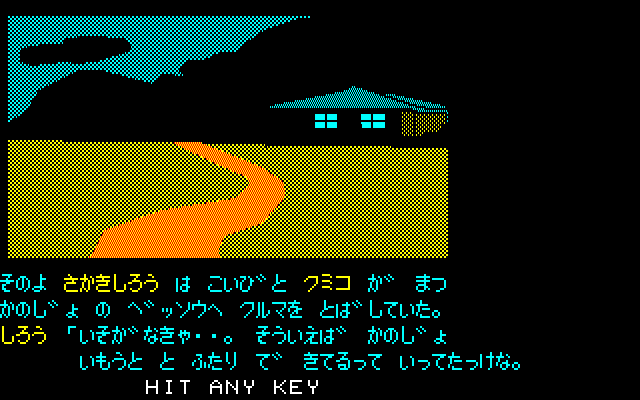
Locations appear as still images from a first-person viewpoint, while a top-down map lets you move the protagonist around Karuizawa. The contrast works well for the game’s structure: the map establishes where you can investigate, then the static location screens hold your attention on the place you have chosen to search.
Story
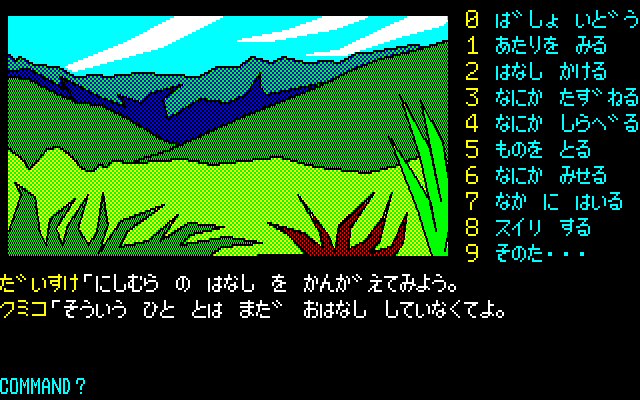
The kidnapping premise gives Karuizawa Yūkai Annai more urgency than a typical vacation-set mystery. Karuizawa begins as a familiar tourist destination, which makes Nagisa’s failure to return from a local supermarket especially unsettling. The game does not need an extravagant premise; the ordinary starting point does the work.
Kumiko’s call to the police and their inability to solve the case create the reason for the private investigation. Her boyfriend steps in, placing you on the trail when the official response has stalled. It is a clean setup, but an effective one, because every bit of information you seek has an obvious emotional stake behind it.
The narrative is best for gamers who like mysteries to unfold through legwork. Rather than treating the investigation as an excuse for disconnected riddles, the game’s exploration and information gathering are tied directly to the search for Nagisa. That focus gives the case a welcome sense of continuity.
Overall Experience
Karuizawa Yūkai Annai is a compactly defined kind of old adventure game: a missing-person mystery, a map of places to check, and a large set of commands through which you test your suspicions. Its strongest quality is commitment. It understands that a detective story can carry a game without constantly interrupting itself for abstract puzzle solving.
Its age shows most clearly in the amount of patience its interface expects. You will be spending time with recurring commands and static screens, and the route forward comes from persistence rather than momentum. If that sounds like a chore, the mystery alone may not convert you. If it sounds like a proper investigation, the game’s measured pace becomes part of the appeal.
Give it a chance if you enjoy early Japanese adventure games and want a case driven by exploration, interviews, and information gathering. It is not a breezy detective fantasy; it is a deliberate search through a troubling disappearance. The payoff is the pleasure of treating every location and lead as part of one grounded case.



Reviews
There are no reviews yet.