 Retro Replay Retro Gaming History, Reviews & Emulation
Retro Replay Review
Gameplay
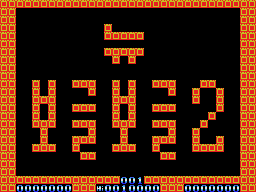
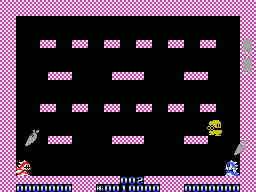
The first few stages make New Boggle Boggle 2’s priorities plain: this is a near-identical return to the Bubble Bobble mold, not a reinvention. You are here for short, fixed-screen platform-action challenges and the satisfying routine of learning how a room’s layout changes the pressure. That directness works in its favor when you want an arcade game that gets moving immediately.
The real reason to play is the stage count. With 150 stages, most of them exclusive to this entry, there is a substantial run of new layouts to work through. Room design matters more than novelty here; familiar action can feel quite different when platforms, routes, and enemy placement force you to rethink your usual approach. A few stages are copied from the prior game, which makes the package feel less essential for veterans, but the bulk is new enough to justify its sequel status.
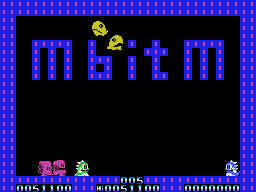
A handful of new enemy types add some variation, though they do not change the central equation. The frustration arrives if you expected the sequel to build meaningfully beyond its predecessor, because it refuses to do that. Treat it as an expansion-sized serving of the same arcade platforming rather than a fresh follow-up, and its repetition becomes a strength: you can settle into the rhythm quickly and concentrate on mastering each layout.
Graphics
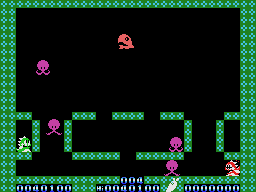
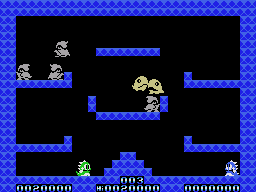
New Boggle Boggle 2 looks identical to New Boggle Boggle, with the same side-view, fixed-screen arcade framing. The notable visual change is therefore in the stage layouts themselves, plus the inclusion of a few new enemy types, rather than in a new look or a broader overhaul.
Story
Story is not what separates this sequel from its predecessor. Its identity is built around repeated arcade challenges, new stage arrangements, and a small enemy refresh rather than a new narrative direction.
That narrow focus suits the game’s old-school structure. Each screen is meant to be a self-contained problem, so the forward pull comes from clearing another stage and seeing what the next layout asks of you.
If you need characters or plot developments to make a long game feel like a journey, 150 stages of closely related action may become tiring. If arcade progression is enough, the changing rooms provide the momentum.
Overall Experience
New Boggle Boggle 2 is an honest but extremely conservative sequel. It has a lot of content for a game built around fixed-screen action, and most of that content is not simply recycled. That matters: new layouts are the one change this formula can genuinely use, because they keep familiar play from turning completely automatic.
Still, the game’s indistinguishability from its predecessor is impossible to ignore. You will not find a different direction here, only a longer route through the same one. The copied stages make that closeness more noticeable, especially if the first game is still fresh in your mind.
Give it a chance if you already have affection for New Boggle Boggle or for Bubble Bobble-style arcade platforming and want a deep stack of additional rooms. Everyone else should start with the earlier game first; this is more of it, often good more of it, but unmistakably more rather than better.


Pixel Archivist –
A six-point-two feels fair for a sequel built around volume rather than change. 150 fixed-screen stages is a solid preservation-era curiosity and gives the layouts room to do the heavy lifting, but copied stages and the near-identical Bubble Bobble formula make it hard to recommend over the first game unless you specifically want more.