 Retro Replay Retro Gaming History, Reviews & Emulation



Retro Replay Review
Gameplay
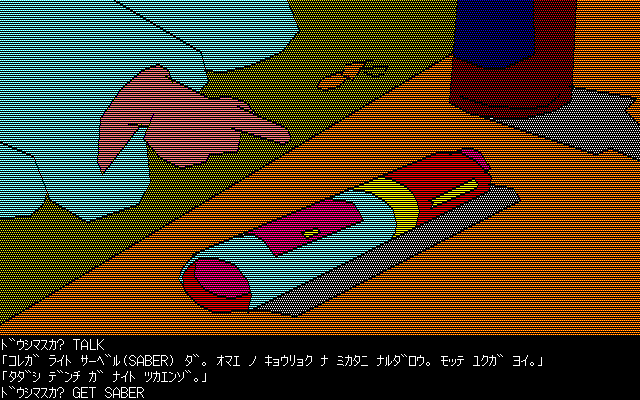
The first few minutes put you in the mindset this game demands: stop looking for a modern objective marker and start treating each location as a puzzle box. You move through first-person still-image locations, inspect the situation through text, and enter simple English commands built around verbs and objects. It is a clean, old-fashioned interaction loop, and the pleasure comes from testing an idea, seeing how the game answers, and gradually working out what matters.
That English parser is also the game’s strangest obstacle. The written text is entirely Japanese, but the game understands commands in English. Even when you know the basic language of adventure games—look, take, use, and similar verb-object thinking—you are negotiating an unusual divide between what you can read and what you are expected to type. For a player comfortable with Japanese, that mismatch may be more curious than fatal; for everyone else, it turns ordinary exploration into a much steeper climb.
Patience is not optional. Text adventures already reward careful wording and a willingness to retry a thought from a different angle, and this one asks you to do that while working around its language setup. Still, there is a specific satisfaction in its restraint. You are not juggling elaborate systems; you are trying to outthink rooms and progress Sir Cucumber’s rescue mission one sensible command at a time.
Graphics
Each location is shown as a static image from a first-person viewpoint, so you face the places Sir Cucumber visits rather than watching him walk around them. The pictures function as the scene for your typed investigations, giving the vegetable-fantasy journey more character than text alone would have.

Story
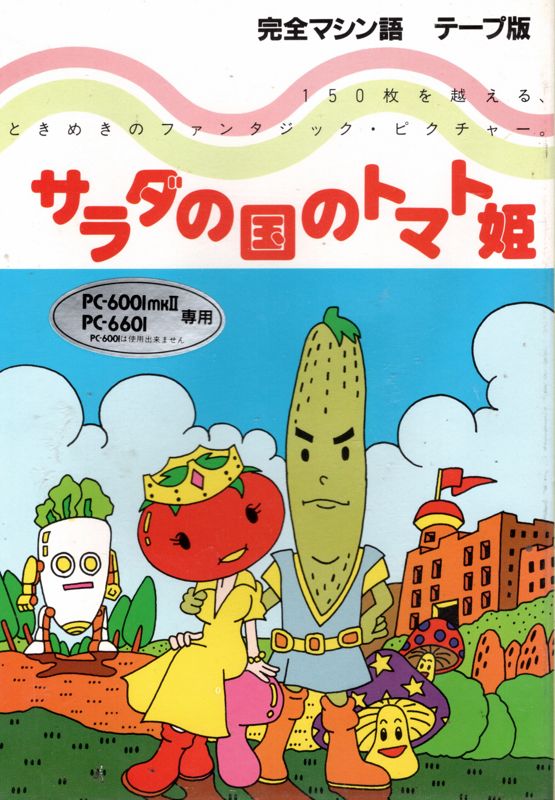
This is a rescue tale told with a straight face and a pantry full of fairy-tale names. Minister Pumpkin betrays the king, kidnaps Princess Tomato, and terrorizes the vegetable kingdom; the king sends Sir Cucumber after both his daughter and his throne. It is immediately understandable, which matters in an adventure where the real effort is often spent interpreting the world and choosing the next command.
The vegetable cast is more than a throwaway joke. Princess Tomato, Sir Cucumber, and Minister Pumpkin give the quest an offbeat storybook flavor that separates it from generic castle-and-dragon fantasy. You may come for the absurdity of the names, but the clear stakes give the wandering a proper purpose.
Because the game is text-heavy and entirely written in Japanese, story enjoyment depends heavily on your ability to follow that text. If you can, the premise has room to carry you through the puzzle solving. If you cannot, the broad rescue setup remains easy to grasp, but much of the narrative texture will be out of reach.
Overall Experience
Salad no Kuni no Tomato-hime is easy to respect and harder to casually recommend. Its core idea is memorable, its first-person illustrated format suits a command-driven adventure, and the vegetable kingdom gives the whole thing a personality that still stands out. Yet the Japanese text paired with English command input is not a minor inconvenience; it is the central condition of playing it.
Give it a chance if you enjoy early text adventures, can read Japanese, or simply have a taste for unusual game-history artifacts with a real sense of humor. The best audience will find a compact puzzle journey beneath the novelty, and may enjoy the slow rhythm of looking, typing, and revising a plan.
For most others, the friction will outweigh the charm. There is no shame in deciding that a rescue mission led by Sir Cucumber sounds more fun than decoding every step of it. But if its peculiar setup clicks with you, this is exactly the kind of oddball adventure whose commitment to its premise can make the struggle feel worthwhile.


Reviews
There are no reviews yet.