 Retro Replay Retro Gaming History, Reviews & Emulation

Retro Replay Review
Gameplay
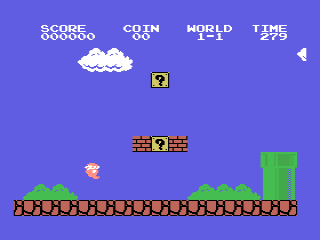
The first hour of Super Boy II is immediately familiar because it asks you to do almost exactly what Super Boy already asked of you: move through 2D side-scrolling stages, clear enemies and obstacles, and push toward the next castle. There is a certain blunt comfort in that. You know the kind of rhythm it wants—keep moving, judge the gaps, and avoid wasting a life—but the sequel does very little to turn that rhythm into a new challenge.
The changed layouts are the reason to play rather than replay the original. Slightly different placements can still make you reconsider a jump or the safest route through a familiar kind of stretch, so this is not literally the same course repeated. But it is an extremely conservative follow-up: the terrain, enemies, and traps do not expand beyond what the first game established. Once you have settled into its basic cadence, there is little new for the game to teach you.
Its stripped-down rule set becomes the main point of friction. The mushroom is the only power-up, while secrets, bonuses, warp zones, and underwater stages are all absent. That leaves little room to recover momentum or break up the march from stage to stage. If you enjoy clean, no-frills platforming and can accept repetition as part of the deal, the focus may feel pleasantly uncomplicated. If exploration and escalating variety are what keep you engaged, Super Boy II runs dry quickly.
Graphics
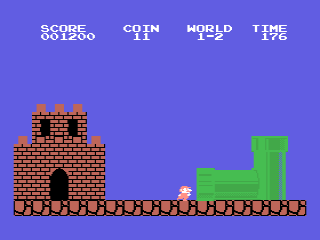
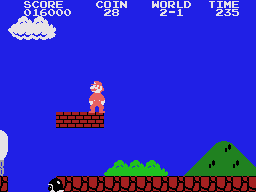
The game reuses the first Super Boy’s look, so you are seeing the same kind of 2D side-view Mario-inspired characters, enemies, terrain, and castle scenes rather than a visual step forward. The layouts change, but the pictures do not meaningfully evolve with them.
Story
Story barely enters the equation. Super Boy II is built around advancing through stages and reaching Bowser encounters, not around narrative development or a changing cast of characters.
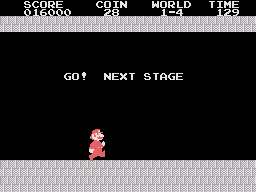
That sparseness would be easier to overlook if the sequel gave its castle stops a stronger sense of progress. Instead, the notable change is a line of text after a Bowser encounter: where the earlier game says “Sorry Nothing,” this one tells you, “Go! Next stage.” It is more direct, though hardly more dramatic.
Think of that message as an honest summary of the game’s attitude. There is no real narrative payoff waiting to reframe the journey; you clear a hurdle and are pointed to the next one. For a short, old-school platform run that may be all you need, but it gives the adventure little personality beyond its familiar template.
Overall Experience
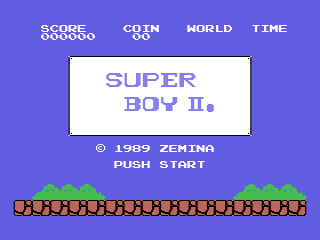
Super Boy II is less a sequel with new ideas than a second helping of the first Super Boy with rearranged courses. That can still have value for a curious retro player: it is a compact look at how a publisher could revise a known platforming formula without changing its ingredients. As a game to sink serious time into, though, it feels static almost immediately.
The payoff depends entirely on how much you enjoy the original’s exact style of play. Returning fans may appreciate having more stages to navigate, even with only modest variations. Everyone else is likely to find that the lack of secrets, alternate stage types, bonus distractions, and additional power-ups makes the journey feel thinner than the source it resembles.
Give it a chance if you specifically want an obscure, unlicensed platformer sequel and are happy with a small remix rather than an upgrade. Otherwise, move on to Super Boy III only if your interest is in following this peculiar series further; Super Boy II itself is mainly for completists and players who want one more familiar set of stages.


Reviews
There are no reviews yet.