 Retro Replay Retro Gaming History, Reviews & Emulation
Retro Replay Review
Gameplay
The first few stages have an immediate, old-school platforming rhythm: move right, judge the next obstacle, avoid enemies, and keep pushing toward the exit. Super Boy III earns a little goodwill by using its own stages rather than simply replaying another game’s layouts. If you know the earlier Super Boy games, that change alone gives this entry a reason to exist.
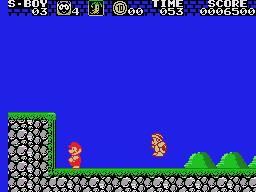
The problem is that Mario walks and runs much more slowly than he does in Nintendo’s platformers. That changes every jump and every stretch of ground into something more deliberate, but not necessarily in a satisfying way. You may spend the first hour waiting for the character to build momentum, especially if your instincts come from faster Mario games. The controls are asked to carry a genre built on quick, elastic movement, and the reduced pace makes the action feel restrained.
Its structure is also unusually rigid. Levels come in a fixed order, with no special stages to break up the march and none of the more distinctive bonus detours associated with the Mario games it borrows from. The only power-ups are from the first Super Mario Bros., so there is less room to experiment once you understand the basics. That simplicity can make it easy to pick up, but it leaves the game with fewer moments of discovery.
Ending every stage with a Hammer Brother is a mixed blessing. It gives each finish line a clear test instead of letting you simply cross a goal, and that can make a successful clear feel earned. Repeating the same kind of boss encounter, though, turns a punctuation mark into routine. Super Boy III is at its best when you treat it as a modest sequence of platforming challenges, not as a substitute for the games it resembles.
Graphics
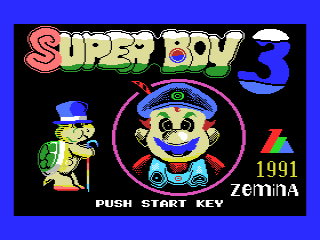
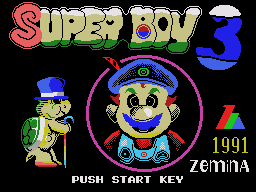
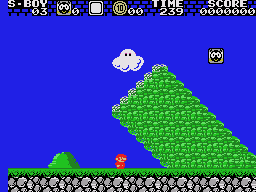
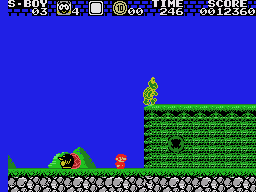
The game uses a 2D side-scrolling view built from familiar Mario-inspired pieces, including enemies and level-design ingredients associated with earlier Mario games and Super Mario World. The straightforward perspective keeps the route ahead easy to parse, while the recurring Hammer Brother finish gives stages a recognizable visual destination.
Story
Super Boy III keeps its narrative framing extremely light. The forward motion comes from clearing the next stage in a fixed sequence, rather than from a changing plot or a set of distinct destinations with their own dramatic purpose.
That stripped-down approach fits the game’s blunt arcade-like loop. You are not being asked to absorb much between stages; the immediate concern is reaching the end and defeating the Hammer Brother waiting there.
For a short-form platformer, that is enough to establish momentum, but it does not add much flavor to the journey. The game’s borrowed Mario elements carry most of the familiarity, while the progression itself remains purely functional.
Overall Experience
Super Boy III is more interesting as a variation on an unauthorized Mario formula than as a platformer you would choose over its obvious influences. Original level layouts distinguish it from its predecessors, and the basic run-and-jump framework still has a dependable pull. There is a real, if modest, satisfaction in learning a route and winning the stage-ending fight.
Yet the slow movement is hard to ignore. It undercuts the quick responsiveness that makes this style of platformer so replayable, and the linear route offers few detours or surprises to compensate. Once the novelty of its altered Mario-like ingredients fades, the game can start to feel like a long walk through a genre built for sprinting.
Give it a chance if you collect Master System or MSX curiosities, or if the history of Zemina’s conversions interests you. Everyone else will likely find the payoff too slight: a competent but constrained platformer with original stages, familiar building blocks, and too little of the speed that made those building blocks exciting in the first place.


Reviews
There are no reviews yet.