 Retro Replay Retro Gaming History, Reviews & Emulation
Retro Replay Review
Gameplay
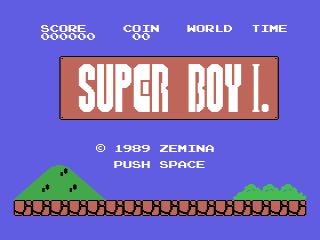
The first few minutes of Super Boy I are disorienting in a very specific way. You are running through a side-scrolling platform game built from Mario sprites and familiar terrain pieces, so your hands expect the usual answers: hunt for secrets, test pipes, look for the fuller range of rewards. Then the game keeps refusing those expectations. Pipes cannot be entered, there are no warp points or bonus stages, and the route is much narrower than its famous template suggests.
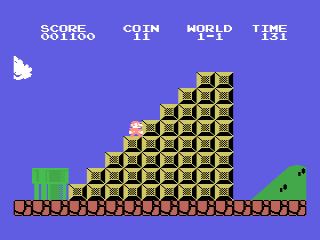
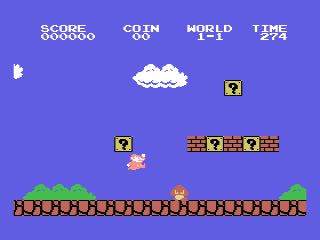
The core jumping and enemy-dodging structure is intact enough to make the game playable, and the early levels resemble Super Mario Bros. closely enough to create a fleeting bootleg fascination. But Super Boy I cuts away the variety that makes that formula breathe. There are no cave or underwater areas, no power-ups beyond mushrooms, and even those mushrooms appear randomly. Falling platforms take the place of elevators, which further underlines how often this version substitutes a rougher approximation for a memorable original element.
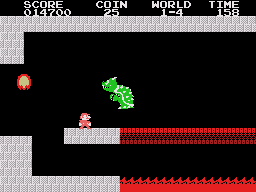
The short campaign also means there is little time for the game to build momentum. Three worlds, each with three stages and a castle, is a brief run, while castles can sometimes be finished without beating Bowser. That can be amusing once, but it drains the final stretches of tension. If you are curious, play it as a historical oddity and enjoy spotting the changes; if you want a platformer to master, the limitations become frustrating fast.
Graphics
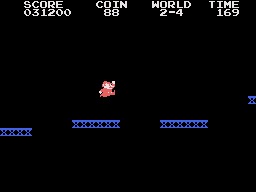
You see Mario, the familiar enemy cast, and recognizable terrain ingredients reworked for the Master System and MSX. Most of the game stays in outdoor areas, while the castles are simplified, sometimes leaving Bowser as the only enemy. The imagery is instantly recognizable, but the reduced selection of locations makes the journey look repetitive long before it ends.
Story
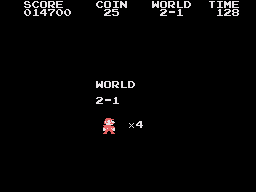
There is barely a story here beyond reaching the end of each course. The princess is not mentioned, so the usual rescue framing never gives the run a reason to matter beyond clearing levels.
Its strangest narrative moment comes at the final castle, where “Sorry Nothing” greets you. That message is more memorable than the game’s actual conclusion, though not in a flattering way.
The abrupt ending fits the whole conversion: it feels incomplete rather than mysterious. You are unlikely to finish Super Boy I for a payoff; finishing it is simply confirmation that the game has run out of material.
Overall Experience
Super Boy I is hard to recommend as a standalone platform game. It borrows the immediate readability of Super Mario Bros., but removes too much of the variety, surprise, and satisfying escalation that make that kind of game endure. The result is not challenging in an interesting new direction; it is mostly a thinner, shorter trip through familiar-looking ground.
Still, there is a small audience for it. If you collect unlicensed Korean releases, enjoy comparing altered conversions, or want to see how a recognizable platforming template was compressed onto the Sega Master System or MSX, it has genuine archival curiosity. Its odd choices—random mushrooms, unusable pipes, sparse castles, and that final apology—give it a personality born from limitation.
Everyone else should treat it as a footnote, not a substitute. For a later entry from the same line, Super Boy 4 is worth investigating as a related curiosity, but Super Boy I itself is mainly interesting for what it strips away.


Reviews
There are no reviews yet.